 English
 Español
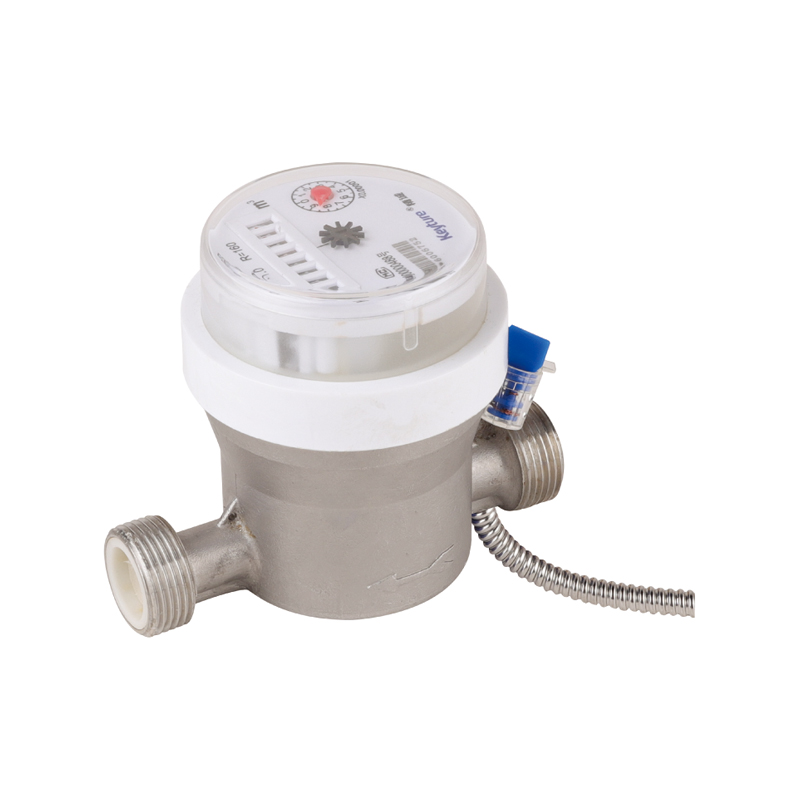
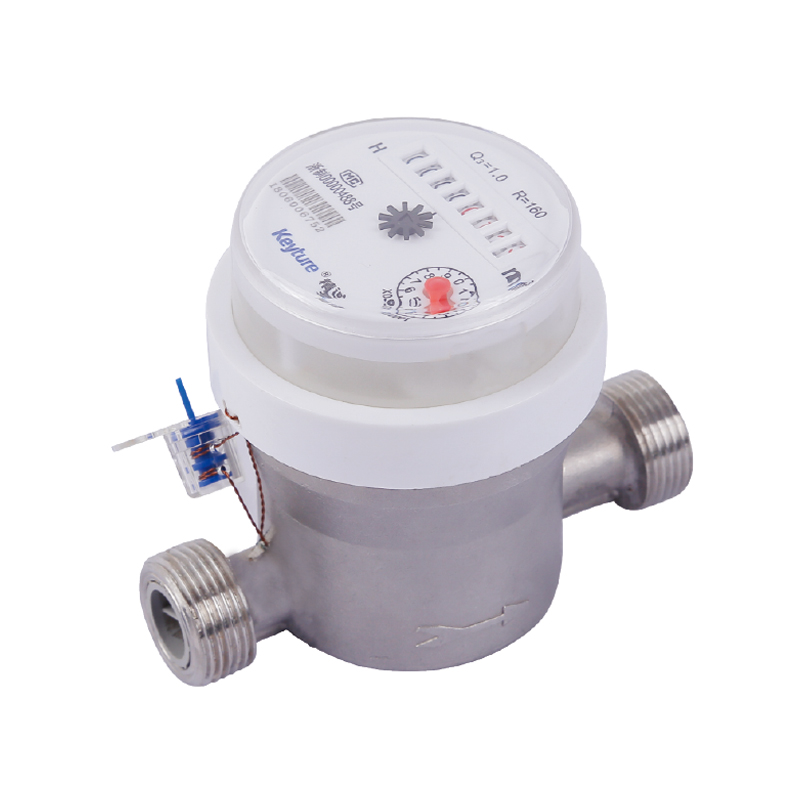
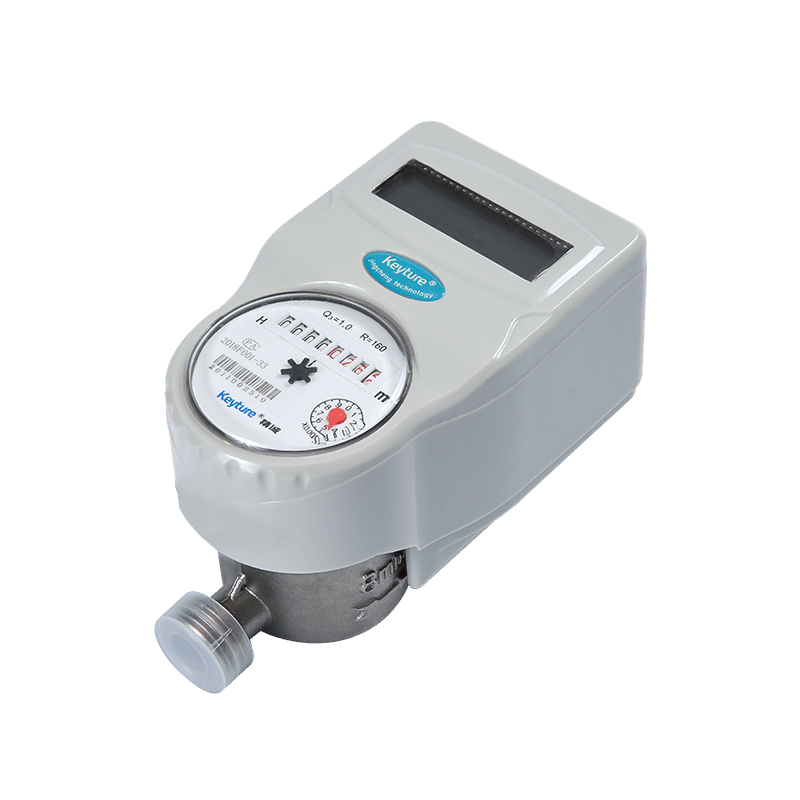
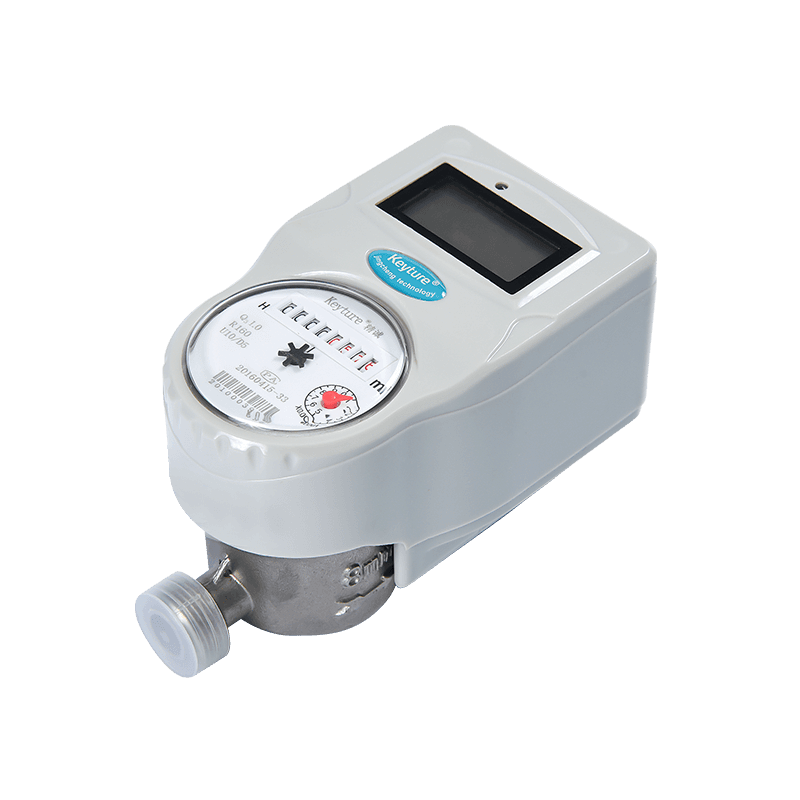
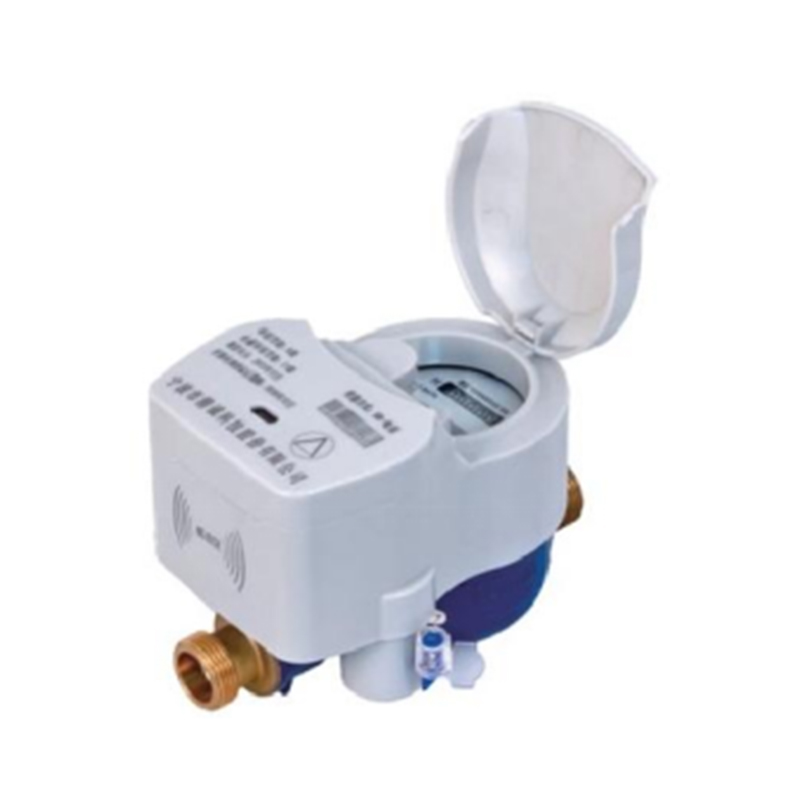
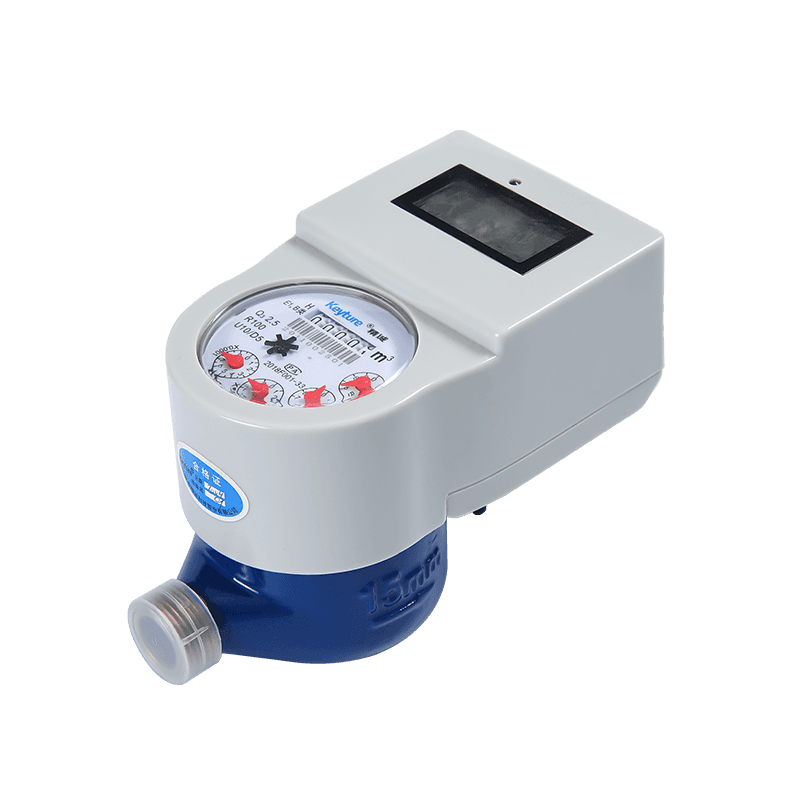
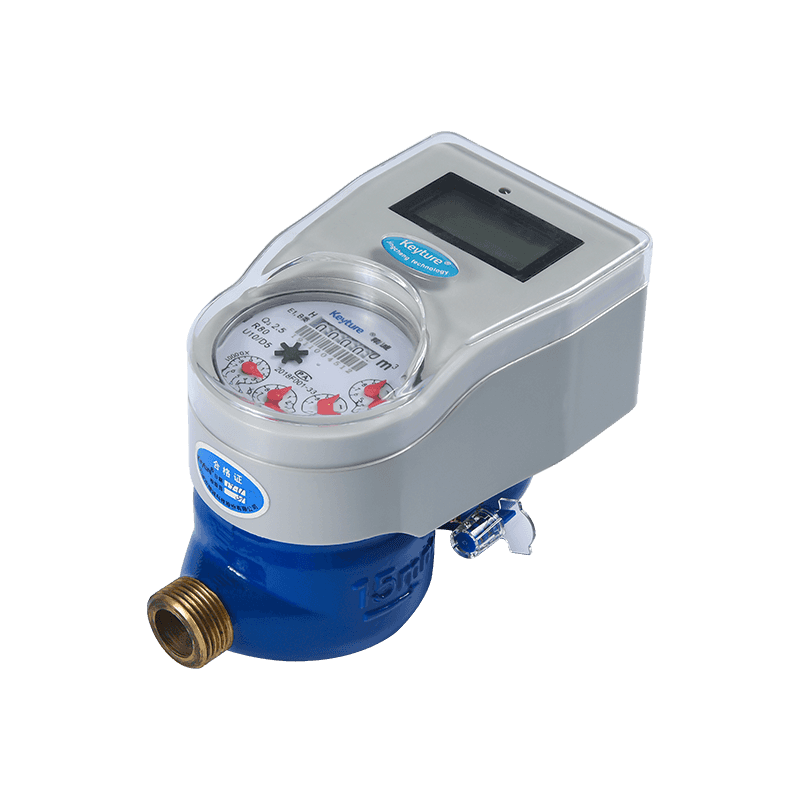
Matches Legacy Tender Language
If your specification says Class C, this meter meets it directly. The label, test report and data sheet can state both the old class and the modern R value to remove any ambiguity.

A positive displacement piston meter specified to the legacy Class C level — and to today’s R160 — for utilities that still write or maintain tenders in the Class A, B, C and D language.
Class C legacy · R160 modern · oscillating piston
A Class C volumetric water meter is a positive displacement meter built to the metrological level that older water-meter regulations called Class C. Before the current ISO 4064:2014 and OIML R49 replaced letter classes with the numerical ratio R = Q3/Q1, meters were sorted into Classes A, B, C and, later, D, according to how low a flow they could measure accurately relative to their nominal flow. Class A was the basic grade, Class B the standard for velocity meters, and Class C the high-sensitivity grade for meters that could hold their error limits down to roughly one hundredth of nominal flow. Class C became the benchmark that volumetric meters were designed to meet, and it still appears in tenders, standards references and utility specifications written in the 1990s and 2000s.
A positive displacement meter is the natural way to reach Class C. Its measuring chamber fills and empties a known volume with every oscillation of the piston, so it does not need water velocity to turn an impeller against friction. It begins registering at a few litres per hour and keeps its error inside the limits at flows where velocity meters under-record by tens of percent. The meter therefore captures the small flows from leaking taps, dripping cisterns and trickle-fed tanks, which in many households make up a surprising share of total consumption. Its measuring element is a circular chamber with a divider plate and an oscillating piston that sweeps the chamber wall; a magnetic coupling carries the piston’s motion to a dry register.
We supply the Class C volumetric meter with the numerical specification that today’s standards use: R160 as standard, which satisfies the traditional Class C requirement with margin. Class C is therefore a bridge between the language of existing tenders and the numerical R-based language of ISO 4064:2014. Each meter is tested at Q1, Q2 and Q3 on a gravimetric bench, marked with its R value and, where tenders require it, with the legacy class designation. Sizes cover DN15 to DN25 with brass bodies, a fine inlet strainer, optional pulse output and a dry-dial register. For utilities updating old tender documents, replacing legacy Class C meters one-for-one or maintaining a fleet that was specified under the old classes, the Class C volumetric water meter offers a precise, familiar and certified match.
Key takeaway: Class C is the old name for ‘measures down to about one hundredth of nominal flow’. A volumetric meter built to R160 meets it with margin — and speaks both the legacy and the modern language of the tender.
Six reasons this specification remains in demand for existing fleets and legacy tenders.
If your specification says Class C, this meter meets it directly. The label, test report and data sheet can state both the old class and the modern R value to remove any ambiguity.
Positive displacement counts every cycle of the chamber, so the meter works at a few litres per hour. Leaks and slow fills are billed, not lost to under-registration.
Because it counts volume rather than velocity, the meter does not need long straight pipes and is unaffected by swirl or pulsation. It can be installed in tight meter boxes and after bends.
Face-to-face lengths and thread sizes match the traditional DN15 to DN25 meters in most networks. Replacement is a one-for-one swap with no change to pipework.
Each meter is tested at Q1, Q2 and Q3 and adjusted to centre the error curve. Test reports are available by serial number for tender documentation.
Pulse and encoder heads fit the dry register, so legacy fleets can move toward AMR without changing the measuring principle.
Standard configuration below. Class designation marking, range ratio and communication can be adapted to your tender requirements.
| Parameter | Specification |
|---|---|
| Standard | ISO 4064 / OIML R49; legacy Class C per ISO 4064-1:1993 / EEC 75/33 |
| Meter type | Volumetric, oscillating piston, positive displacement |
| Nominal diameter | DN15 – DN25 (1/2" – 1") |
| Accuracy class | Class 2, R160 standard (legacy Class C) |
| Starting flow | ≤ 3 L/h (DN15) |
| Measuring chamber | Engineered polymer, divider plate and oscillating piston |
| Register | Dry-type, magnetic coupling, 6-digit odometer |
| Water temperature | 0.1 °C – 50 °C (cold water) |
| Working pressure | MAP 16 bar |
| Pressure loss | ≤ 0.1 MPa at Q3 |
| Body material | Forged brass, lead-free options |
| Strainer | Fine 100-mesh stainless steel strainer, mandatory |
| Connection | Threaded G3/4" – G1¼" |
| Installation | Horizontal or vertical according to marking |
| Pulse output | Optional reed or Hall head, 1 L / 10 L per pulse |
| Marking | R value; legacy class designation on request |
| Protection | IP65 standard; IP68 on request |
Q4 is the overload flow, Q3 the permanent flow, Q2 the transitional flow and Q1 the minimum flow, all expressed in m³/h.
| Nominal Diameter | Q4 Overload | Q3 Permanent | Q2 Transitional | Q1 Minimum | Range Ratio | Legacy Designation |
|---|---|---|---|---|---|---|
| DN15 (1/2") | 3.125 | 2.5 | 0.025 | 0.01562 | R160 | Class C |
| DN20 (3/4") | 5 | 4 | 0.04 | 0.025 | R160 | Class C |
| DN25 (1") | 7.875 | 6.3 | 0.063 | 0.03938 | R160 | Class C |
Values shown for R160. Legacy class definitions in ISO 4064-1:1993 / EEC 75/33 use Qn and Qmin; the R160 values here exceed the requirement. Please check the exact wording of your tender and we will confirm the correct marking.
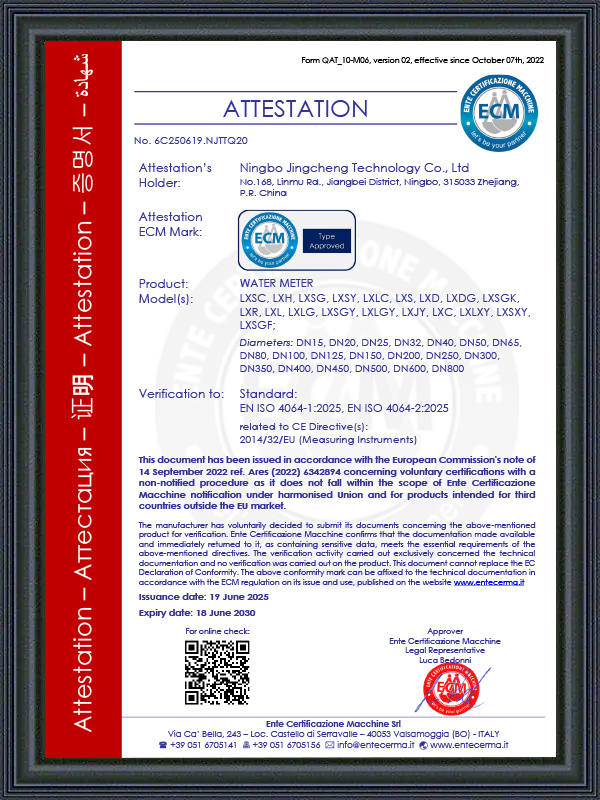
A Class C meter has to satisfy today’s standard as well as the legacy class definitions that appear in older documents.
Current standard, defining Class 1 and Class 2 meters by the range ratio R = Q3/Q1. Our R160 meter is verified against Class 2 limits at Q1, Q2, Q3 and Q4.
The earlier standard, which defined Classes A, B, C and D by the ratio of nominal flow Qn to minimum flow Qmin. Class C required an approximate 100:1 ratio; our R160 exceeds it.
The directive that defined Classes A, B and C for cold water meters in the European Community, long used in tender specifications.
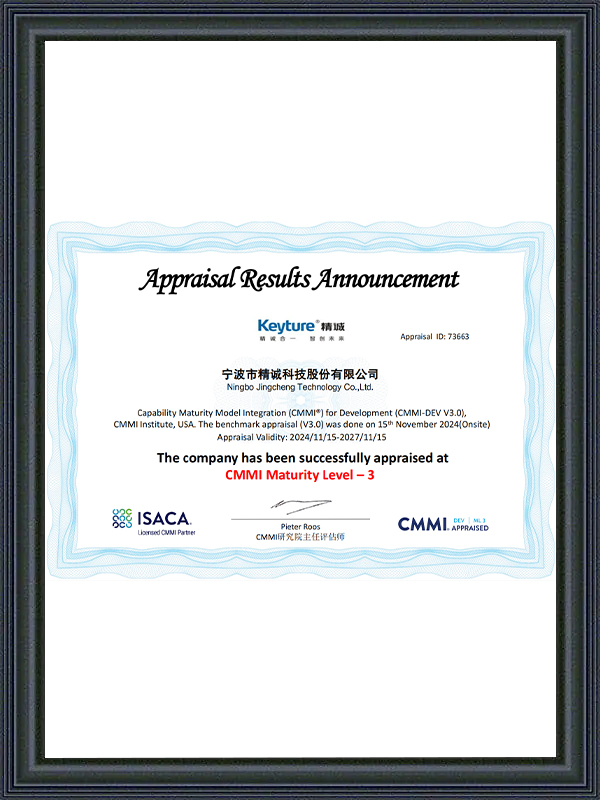
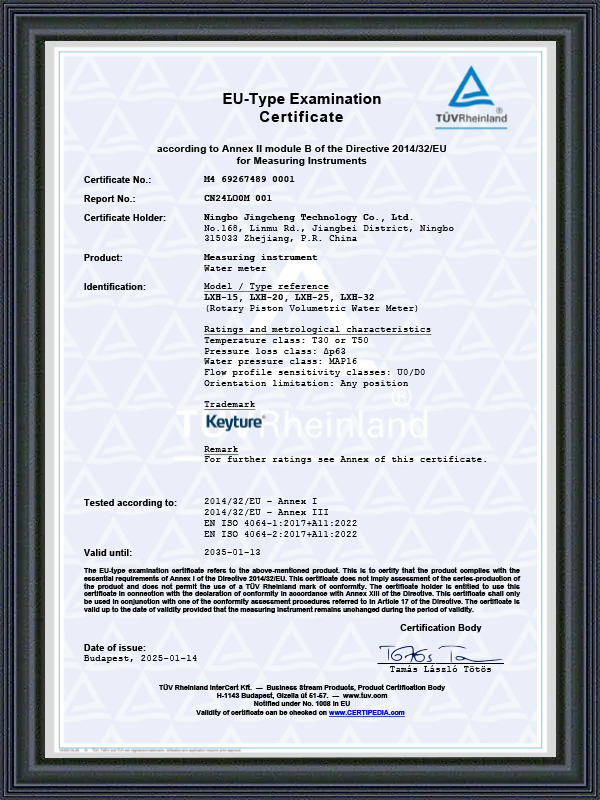
EU MID approval, which uses the modern R-based language, with the label stating R160 and, if needed, the legacy class.
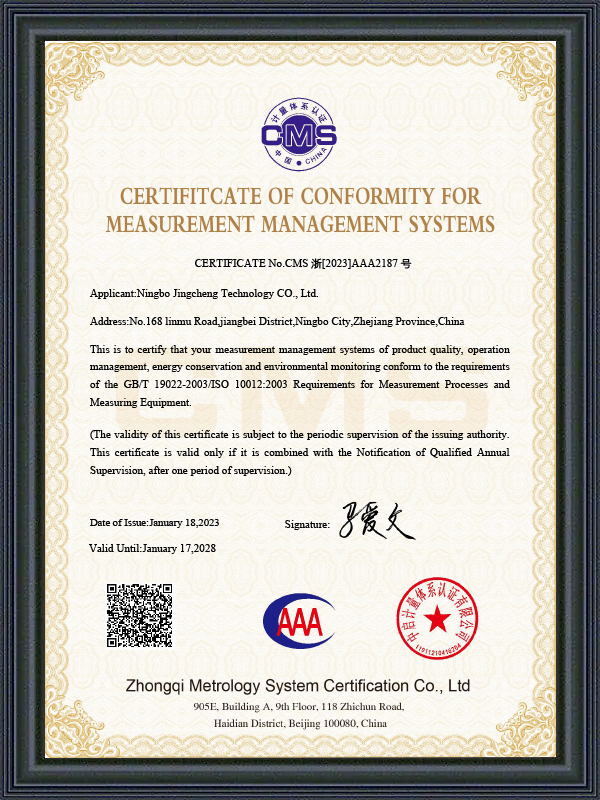
Starting flow and Q1 error are tested on every batch, since Class C sensitivity is the main purpose of the meter.
Brass and polymer materials in contact with drinking water can be supplied with NSF/ANSI 61, WRAS or ACS certificates.
Two ideas define this meter: how the old letter classes map to the modern R value, and how an oscillating piston counts volume.
Under the old system, a meter’s class depended on the ratio of its nominal flow Qn to the minimum flow Qmin at which it still met its error limits. Class A was about 25:1, Class B about 50:1, Class C about 100:1 and Class D about 125:1 or higher. The exact figures varied slightly with the size of the meter, and the older Qn is not identical to the modern Q3, so conversions are approximate.
The modern standard drops the letters and states R directly as the ratio of permanent flow Q3 to minimum flow Q1. A meter with R160 has a minimum flow one one-hundred-and-sixtieth of permanent flow. That is more demanding than a legacy Class C meter, so it can be supplied as ‘Class C’ with margin. Marking both values on the meter and in the documents lets buyers and inspectors compare like with like.
The measuring chamber is a circular cavity with a fixed divider plate. A hollow cylindrical piston, slotted to straddle the divider, is pushed around the chamber by the incoming water, its outer surface rolling along the wall while its slot slides along the divider. In each full oscillation, the piston sweeps out and discharges a precisely known volume of water. The movement of the piston centre is transmitted by a magnet to the register.
Clearances between piston and chamber are a fraction of a millimetre, which gives the meter excellent sealing and the ability to count at very low flow. It also means the water must be clean: a fine 100-mesh strainer sits at the inlet. Chambers and pistons are made from low-friction engineering polymers with stable dimensions, so calibration is repeatable and wear is slow in clean potable water.
Measured performance data for the Class C volumetric water meter. Use these charts to confirm pressure loss, accuracy and installation dimensions before specifying.
Figure 1 — Head loss curve (MPa vs. flow m³/h)
The chart shows pressure loss across the Class C volumetric meter at DN15, DN20 and DN25. All flow passes through the chamber, so loss is higher than in a velocity meter, but remains at or below 0.1 MPa at permanent flow.
Figure 2 — Accuracy error curve (Class 2, R160, Q1–Q4)
At Q1, one one-hundred-and-sixtieth of Q3, the error is already inside ±1.5%, far better than the ±5% limit. The curve is flat through the middle of the range, with a slight negative drift at high flow caused by internal slip. This is the typical positive displacement signature.
Figure 3 — Installation dimensions (L × H × B × D)
| Size | L (mm) | H (mm) | B (mm) | D (thread) |
|---|---|---|---|---|
| DN15 | 165 | 105 | 86 | G3/4" |
| DN20 | 190 | 110 | 88 | G1" |
| DN25 | 260 | 128 | 110 | G1¼" |
Dimensions are for reference. Confirm exact values with our engineering team before installation design.
Tenders written in different eras use different language. This table relates the legacy letter classes to the modern R value and to typical meter types.
| Legacy Class | Approximate Qn / Qmin | Typical Modern R | Typical Meter Type |
|---|---|---|---|
| Class A | About 25 : 1 | R25 – R40 | Basic single jet, older stock |
| Class B | About 50 : 1 | R50 – R80 | Standard single and multi jet |
| Class C | About 100 : 1 | R100 – R160 | Volumetric piston, high-grade multi jet |
| Class D | About 125 : 1 or more | R200 – R400 | Volumetric piston, ultrasonic |
| Modern R160 (this meter) | 160 : 1 | R160 | Volumetric piston |
| Modern R250 / R315 | 250 – 315 : 1 | R250 – R315 | Premium volumetric |
| Modern R400+ | 400 : 1 or more | R400 – R800 | Ultrasonic |
| Use of mapping | Indicative only | Check each tender | Confirm with standard text |
This mapping is approximate. The exact definitions depend on the standard edition and meter size. Always check the original standard and your tender text, and contact our engineers for guidance.
Premium quality
since 2002
Coming From China, Marketing To The World
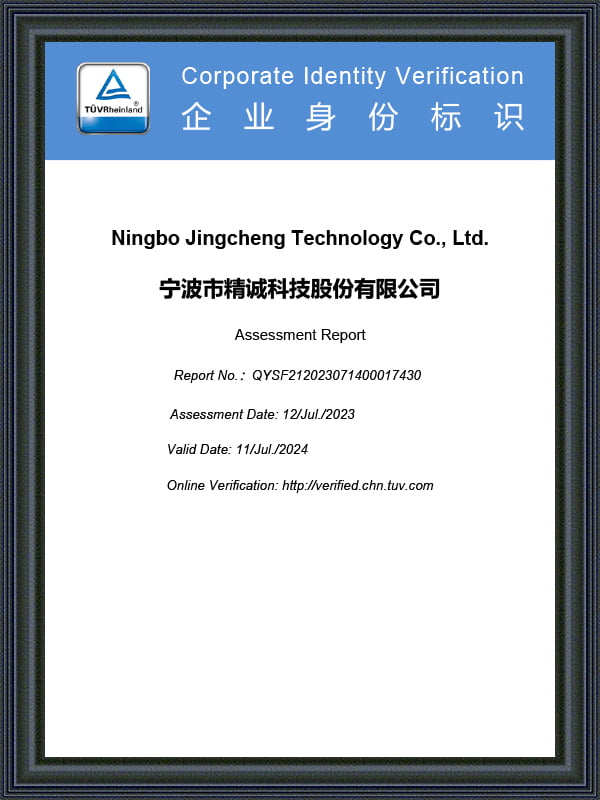
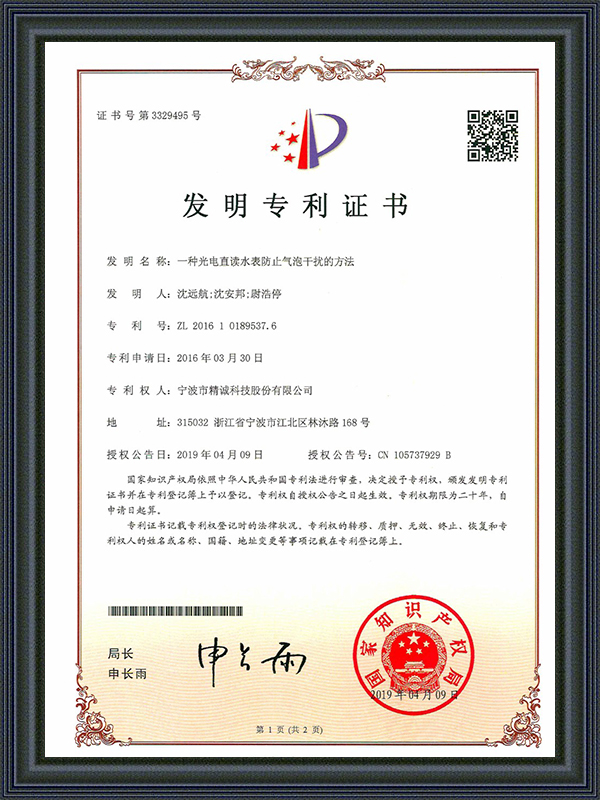
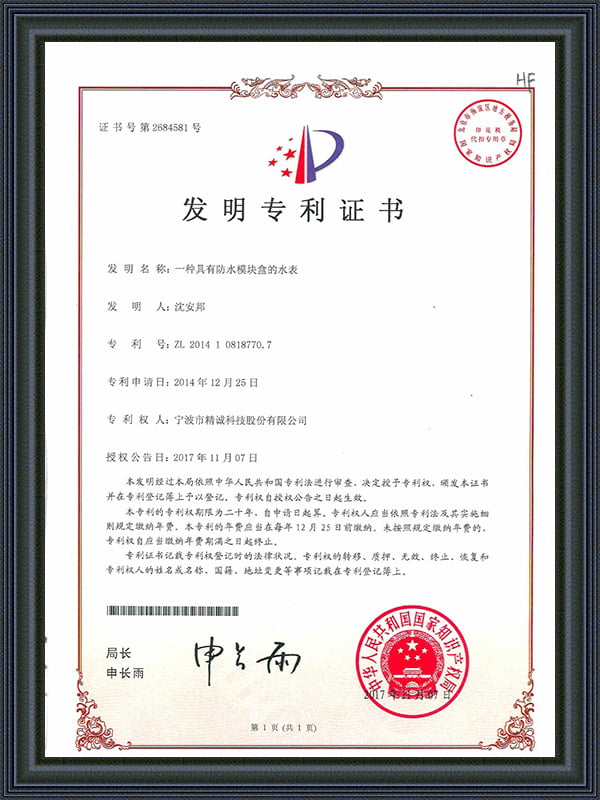
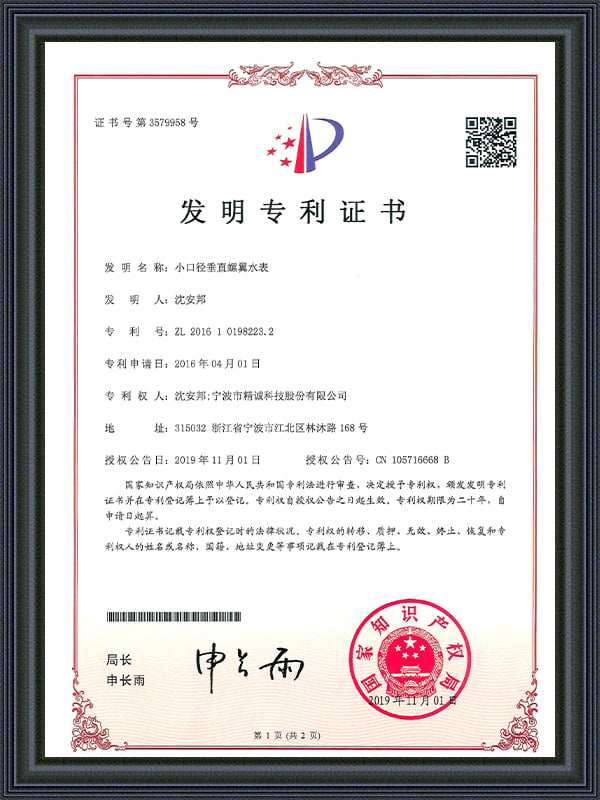
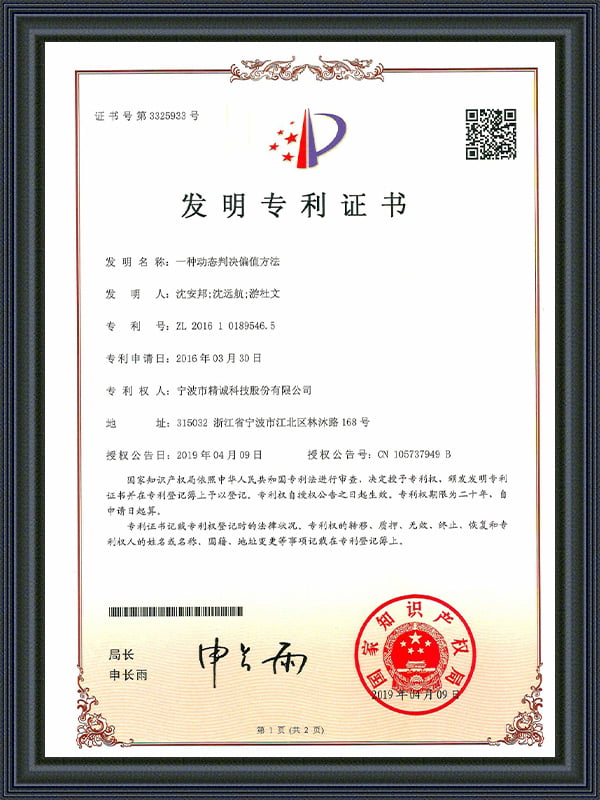
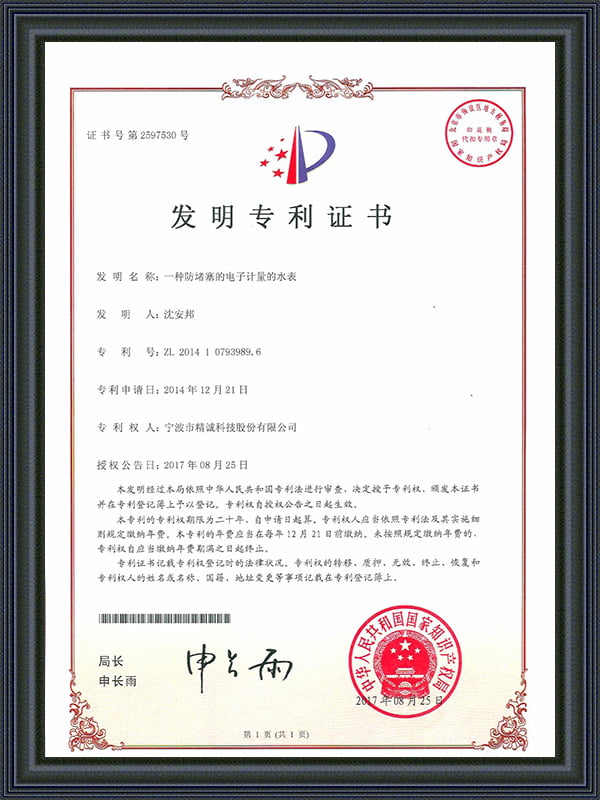
Keyture Meter is located in Picturesque Jiangbei Investment Park, NINGBO, CHINA. It is a comprehensive high-tech China Class C Volumetric Water Meter Manufacturers and Custom Class C Volumetric Water Meter Factory that integrates scientific research & development, production, sales, and service. Established in 2002 as a manufacturer and exporter of water meters for more than 22 years. The factory covers an area of 40 acres (30,000 square meters), 200 staff, 100+ types of products, product capacity of 5 million per year. Its product range covers single jet, multi-jet, volumetric piston type, Woltman type, IC card intelligent water meter, remote control water meter, optoelectrical reading direct remote control water meter...
Yearly production capacity
Production Area
Works and inspectors
Production experience
Excellent product with exquisite craftsmanship
Customization
We have a strong R&D team, and we can develop and produce products according to the drawings or samples the customers offered.
Cost
We are a professional manufacturer and also have our own processing machinery. So we can offer good prices and good products directly.
Quality
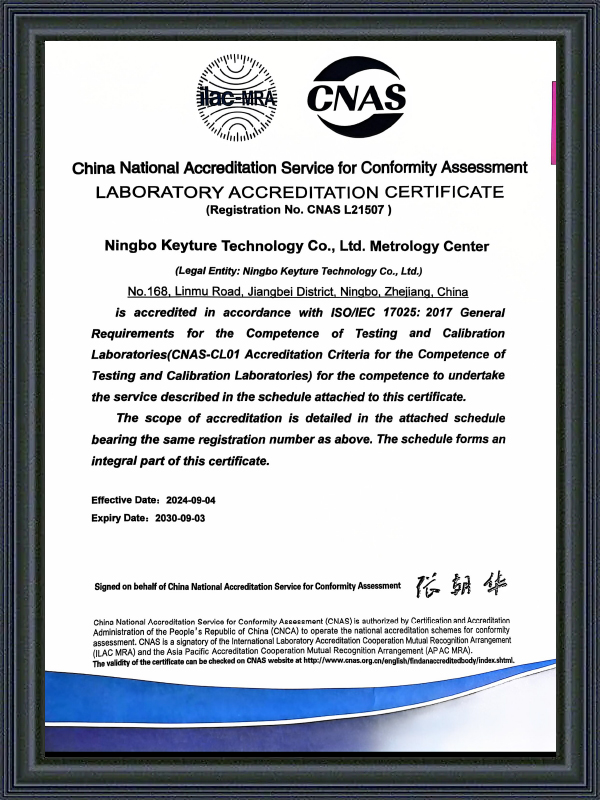
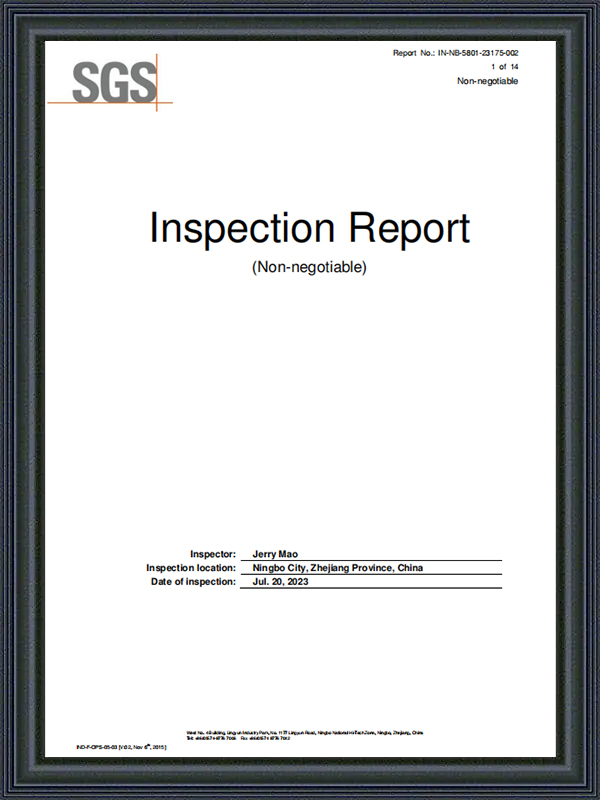
We have our own testing lab and advanced and complete inspection equipment, which can ensure the quality of the products.
Service
We focus on developing high-quality products for top-end markets. Our products are in line with international standards, and are mainly exported to Europe, America, Africa, Asia and other destinations around the world.
Capacity
Our annual production capacity is over 5 million units. We can meet the needs of different customers with different purchase quantities.
Shipment
We are about 35 kilometers away from Ningbo Port. It is very convenient and efficient to ship goods to any other countries.
From mechanical meters to smart AMR/AMI systems — we provide end-to-end water metering solutions tailored to your project.
Chosen where older specifications call for Class C or where low-flow accuracy is needed in a conventional meter format.
Install a fine strainer, 100 mesh or finer, directly upstream of the meter, and flush the pipework thoroughly before fitting. Debris left by plumbing work is the most common cause of jammed or worn pistons. For new construction, flush at high velocity through a temporary spool before the meter is installed.
The meter is not sensitive to flow profile, so it can follow elbows and valves directly. Fit it in the orientation shown on the dial — horizontal or vertical according to the marking — and in the direction of the flow arrow. Open valves slowly to avoid hydraulic shock.
Bleed air from the line before commissioning, because air passing through a positive displacement meter is counted as water. Record the meter’s R value and class marking in the asset register and seal the register with a lead wire.
The strainer is the main service item. A partially blocked strainer raises pressure loss and, in a piston meter, can starve the chamber. Inspect and clean it at intervals suited to local water quality. If starting flow rises noticeably, check the strainer first and then the measuring cartridge.
A replaceable measuring cartridge lets utilities refurbish meters at the end of their verification period. After replacement, the meter is recalibrated at Q1, Q2 and Q3 and resealed.
In clean potable water, 6 to 8 years of accurate service is typical. Legacy fleets should be sampled and tested at that point to decide whether to extend or replace, using the same method as in the original tender.
It is a legacy accuracy class from ISO 4064-1:1993 and EEC Directive 75/33. It describes a meter able to maintain its error limits down to a minimum flow of roughly one hundredth of nominal flow. Current standards describe the same idea with the range ratio R.
Approximately, but not exactly. Legacy classes were defined by Qn and Qmin, and Qn is not identical to the modern Q3. Class C is in the region of R100 to R160, so an R160 meter exceeds it.
Positive displacement meters count volume directly and start at a few litres per hour, so they can meet the Class C low-flow requirement more easily than velocity meters.
Yes. The dial and data sheet can show R160 as the modern marking and Class C as the legacy designation where the tender requires it. The label does not change the metrological performance.
Yes. Class 2 limits of ±5% in the lower zone and ±2% in the upper zone apply. The difference is the range ratio — how low Q1 is relative to Q3.
Typically 3 L/h or less for DN15 and a little more for larger sizes. Starting flow is verified on each batch and reported on the certificate.
No. A volumetric meter is not sensitive to the flow profile, so it can be installed after elbows, valves and tees without loss of accuracy.
Clean potable water. The piston clearance is small, so sand and scale can jam or wear it. A fine strainer is mandatory and additional filtration is advised in areas with sediment.
Yes. The face-to-face lengths and thread sizes match common Class C meters in DN15 to DN25. Confirm the thread standard and length of your installed meters before ordering.
Yes. Pulse and encoder heads fit the dry register. Specify the interface at order stage so the correct register and head are supplied.
Sand can scratch the chamber and jam the piston. Fit a fine external strainer, flush the line and consider a velocity meter or ultrasonic meter for very dirty supply.
Typically 6 to 8 years in clean water. The measuring cartridge can be refurbished for a second service life after re-calibration.
Send us the class designation, sizes and quantity in your specification. Our engineers will confirm the matching Class C volumetric configuration and marking, with price and lead time.

Address: No.168,LinMu Rd.,Zone B, Jiangbei investment Park, Ningbo, Zhejiang,China
Tel: +86-0574-83090480/+86-18892665118
Fax: +86-0574-83021045
Email: [email protected]
Web: https://www.keyturemeter.com/
Quick Links
Product
Mobile terminal
 Custom Class C Volumetric Water Meter Manufacturers