 English
 Español
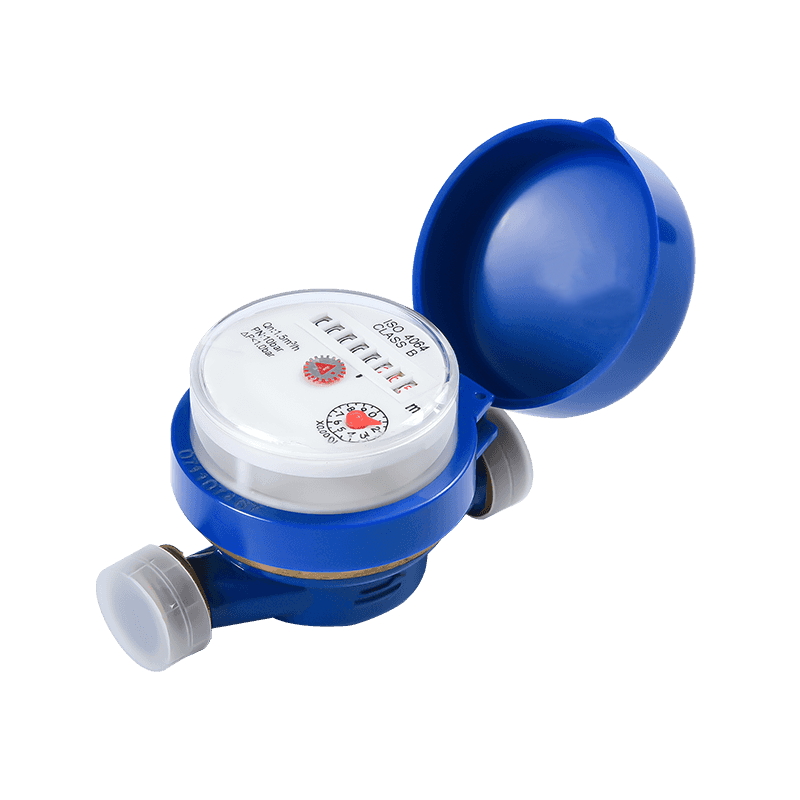
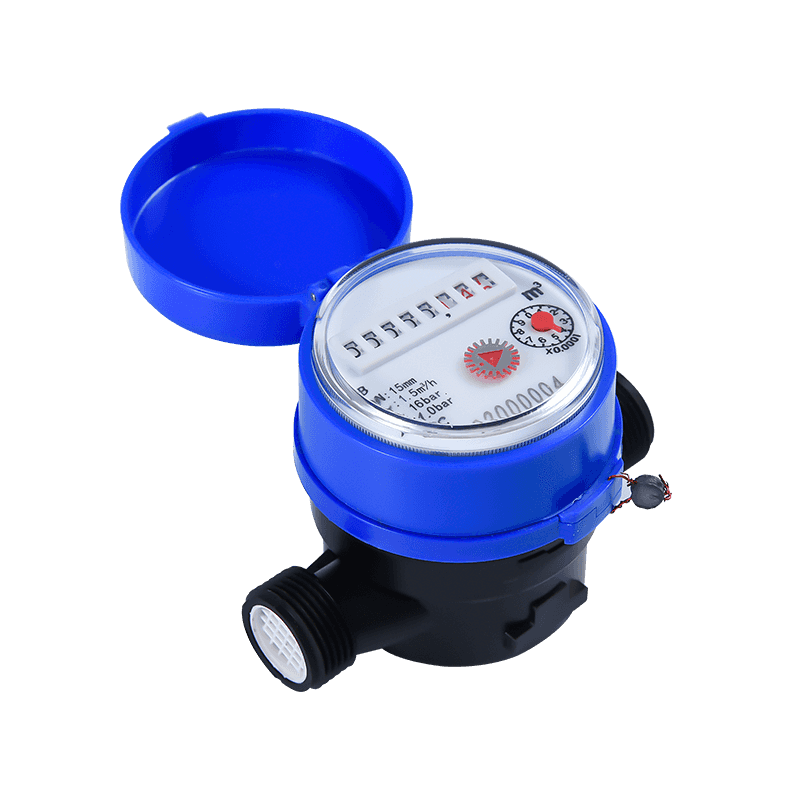
Lowest Cost per Connection
Injection moulding replaces forging and machining, cutting material and labour. In tenders measured in hundreds of thousands of units, the unit price advantage is the biggest single saving.

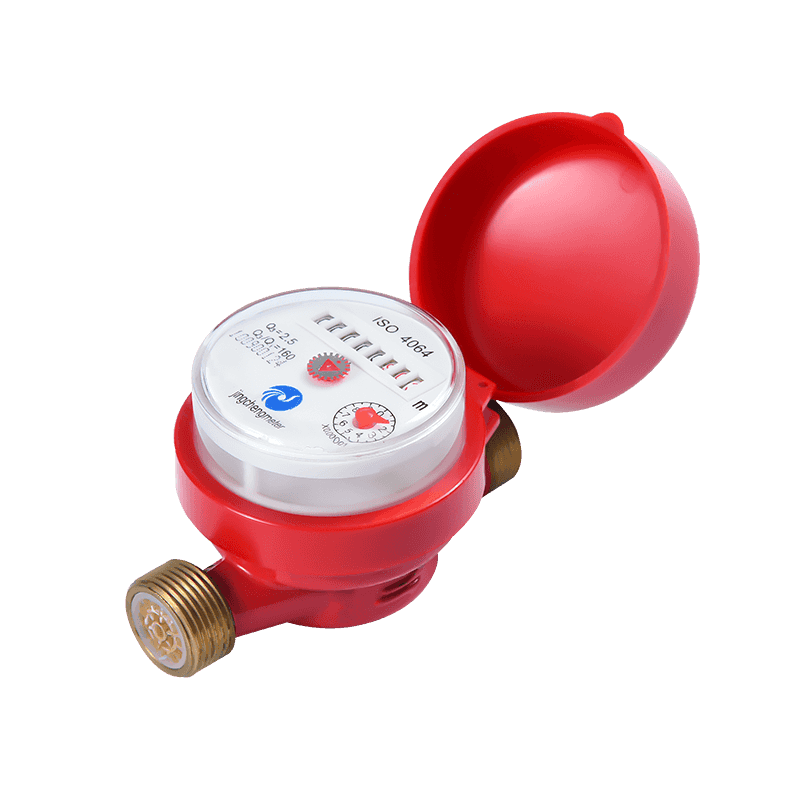
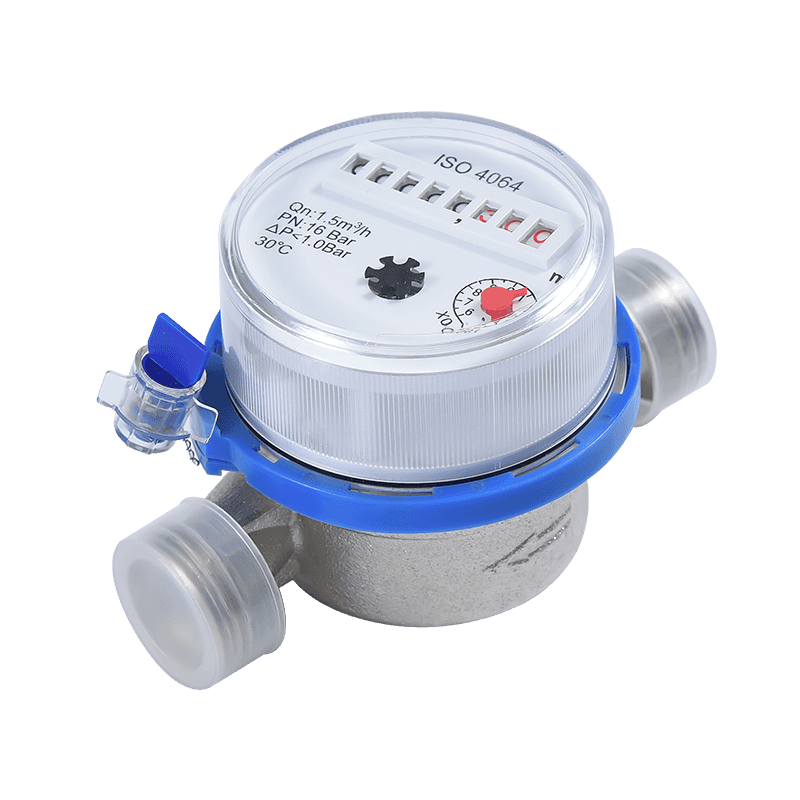
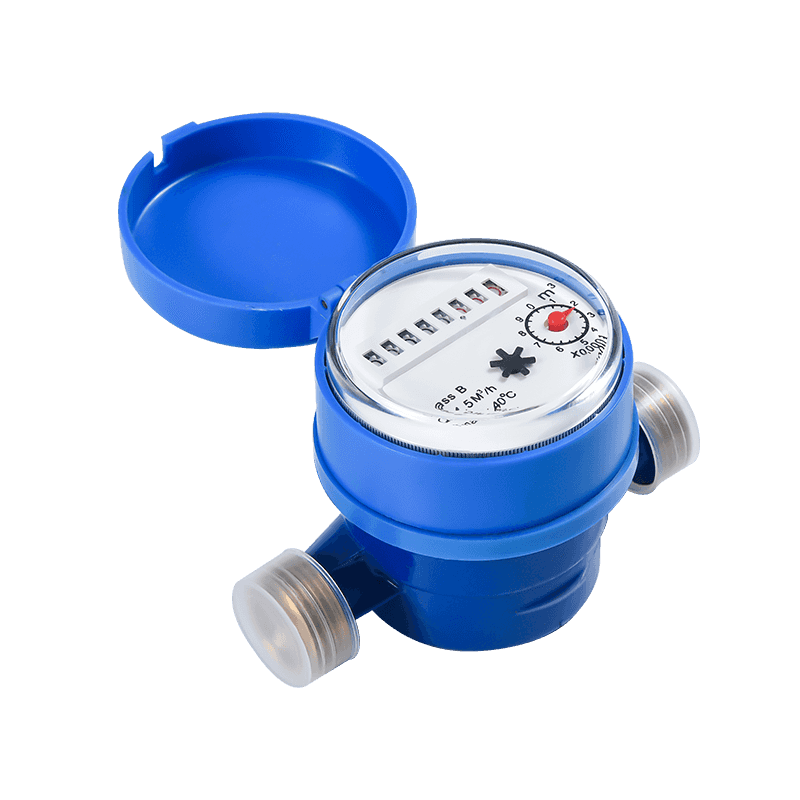
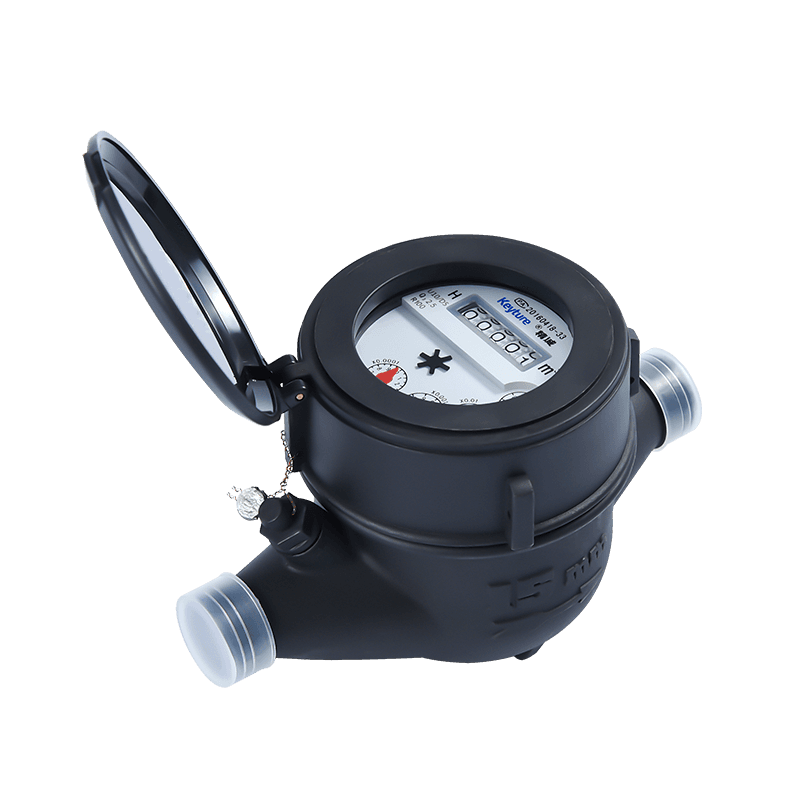
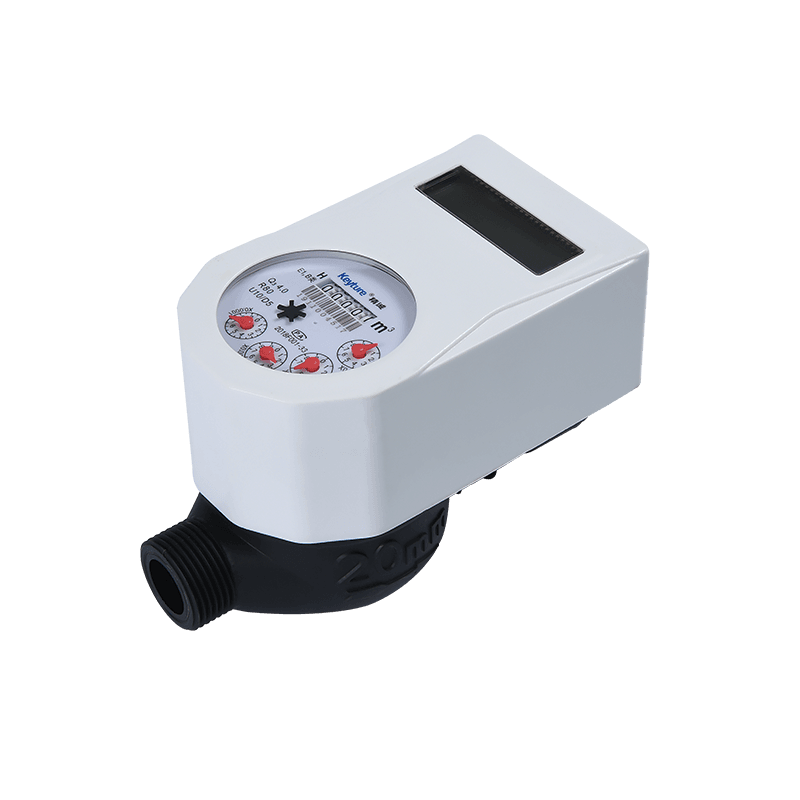
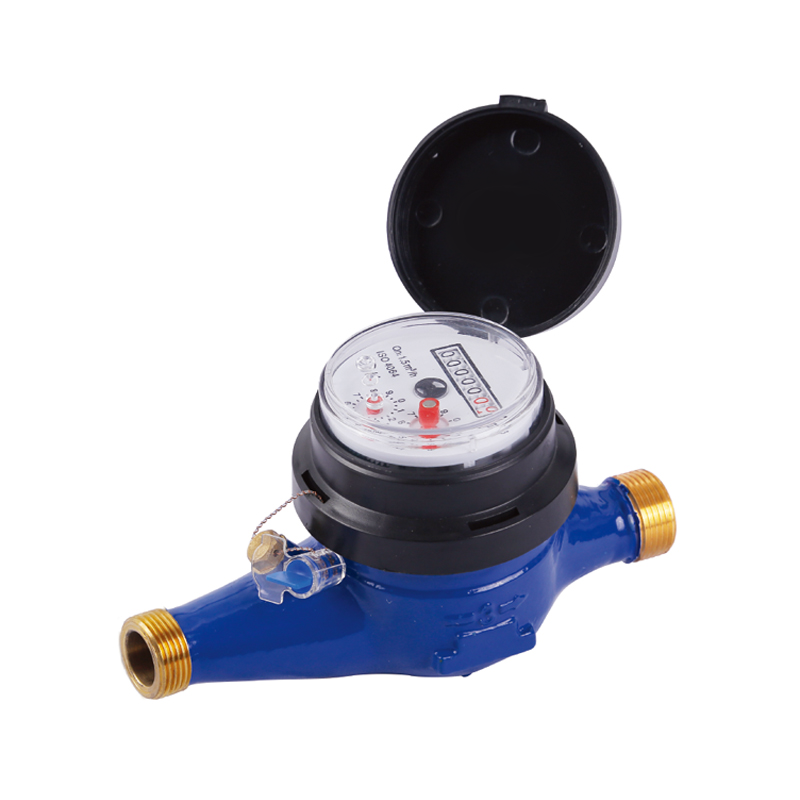
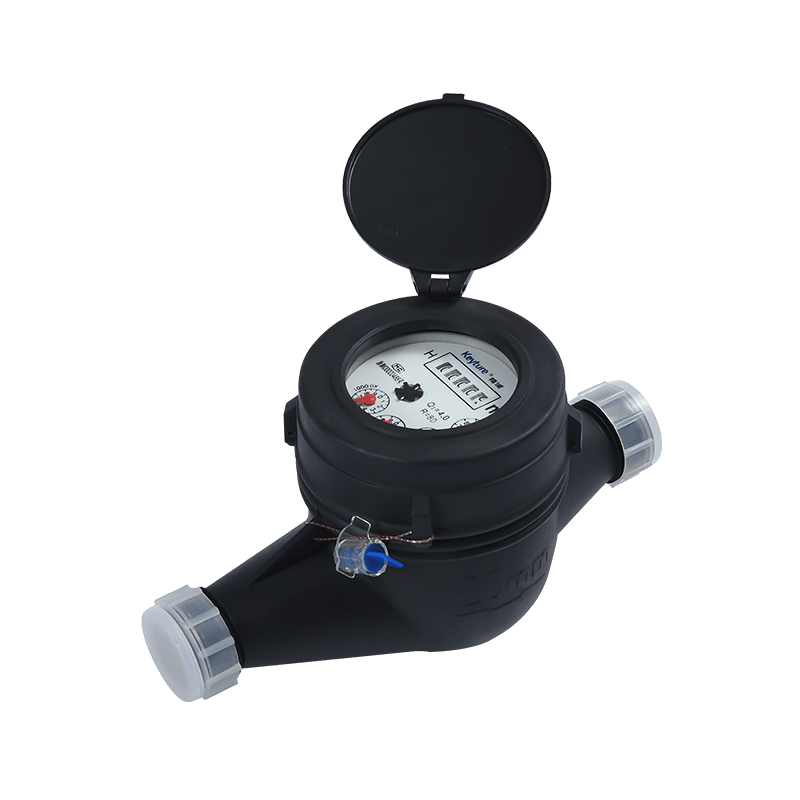
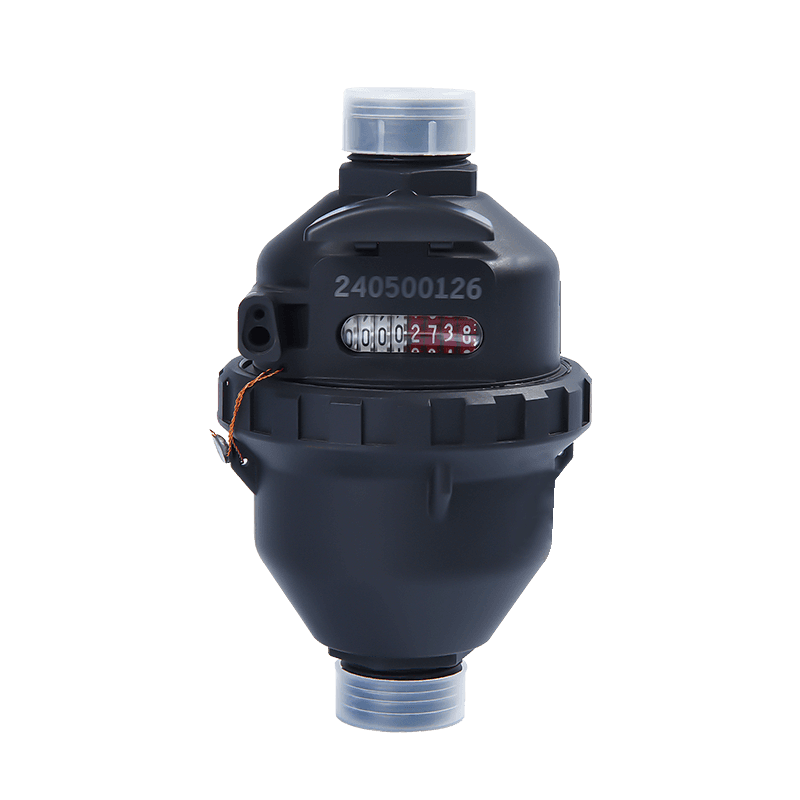
A lightweight, corrosion-proof single jet meter in moulded engineering plastic — the economy choice for residential programmes that need certified accuracy at the lowest cost per connection.
Moulded polymer body · single jet · sealed unit · lead-free
A plastic body single jet water meter is a household velocity meter whose housing is injection moulded from engineering thermoplastic instead of cast or forged from metal. Inside, the measuring principle is the familiar single jet: water is accelerated through one tangential nozzle onto a vane wheel, whose rotation is proportional to flow velocity and is transferred through a magnetic coupling to a dry register. What changes is the economics and the material behaviour. A moulded polymer body costs a fraction of a machined brass body, weighs about a third as much, never corrodes, contains no lead and no copper, and can be produced in millions of identical pieces with very tight repeatability. For large residential roll-outs where price and consistency drive the tender, plastic is the rational choice.
The housing is typically made from glass-fibre-reinforced polypropylene, PPO or polyamide blends selected for dimensional stability, creep resistance and approval for drinking water contact. Ribs and bosses are designed with finite-element analysis so the body holds 10 or 16 bar working pressure with a generous burst margin, and threaded tailpieces are either integrated or supplied as separate brass or polymer connectors. The register and chamber are ultrasonically welded or snap-locked, so the meter is a sealed unit. Because plastic is a thermal and electrical insulator, the body does not conduct stray currents, does not sweat as readily in humid meter boxes and does not attract the galvanic corrosion that affects brass-to-steel connections.
This simplicity comes with clear boundaries. Polymers soften and creep at high temperature and under sustained stress, so the plastic body single jet meter is designed for cold water up to 40 °C, PN10 service and installations protected from direct sunlight and heavy impact. It is generally treated as a sealed-for-life product, replaced at the end of its verification period rather than refurbished. Supplied in DN15 and DN20 with Class 2 accuracy per ISO 4064 / OIML R49 and an R80 range ratio, with optional pulse output for AMR, it is the economy meter for new-build housing, tenant metering, rural supply and any programme that needs the lowest cost per connection without sacrificing certified accuracy.
Key takeaway: Plastic trades refurbishability for price, weight and corrosion immunity. If you want the lowest cost per connection on clean cold water, a moulded single jet meter delivers certified Class 2 accuracy at a fraction of the weight.
Six advantages that make polymer-bodied meters the volume choice for cold water residential metering.
Injection moulding replaces forging and machining, cutting material and labour. In tenders measured in hundreds of thousands of units, the unit price advantage is the biggest single saving.
Polymer does not rust, dezincify or pit. The meter is unaffected by aggressive soils, chlorine, condensation or stray currents, and does not stain the meter box or pipe fittings.
At roughly one third the weight of a brass meter, shipping cost falls and installers carry more units per trip. Lighter weight also reduces stress on plastic pipework.
With no metal in the body, there is no lead or copper to leach into potable water. Compliance with drinking water regulations is simpler, and no dezincification issues arise.
Moulded parts are identical from shot to shot, so chamber geometry and nozzle dimensions are highly repeatable. This translates into tight batch-to-batch calibration.
The body does not conduct heat or electricity, which reduces condensation on the exterior and eliminates galvanic corrosion at connections.
Standard configuration below. Polymer grade, connection type and pulse options can be adapted to your market requirements.
| Parameter | Specification |
|---|---|
| Standard | ISO 4064 / OIML R49 |
| Meter type | Single jet, vane wheel, velocity type, dry register |
| Nominal diameter | DN15 – DN20 (1/2" – 3/4") |
| Accuracy class | Class 2, R80 |
| Body material | Glass-fibre-reinforced PP / PPO / PA blend, potable-water grade |
| Water temperature | 0.1 °C – 40 °C (cold water only) |
| Working pressure | MAP 10 bar standard / 16 bar on request |
| Pressure loss | ≤ 0.1 MPa at Q3 |
| Construction | Ultrasonically welded or snap-locked, sealed for life |
| Impeller | Engineered polymer with steel or ruby pivot |
| Register | Dry-type, magnetically coupled, 5-digit + pointers |
| Connection | Threaded G3/4" – G1" via brass or polymer tailpieces |
| Strainer | Integral polymer mesh strainer |
| Installation | Horizontal (H) only; arrow moulded on body |
| Pulse output | Optional reed switch, 1 L / 10 L per pulse |
| UV exposure | Indoor or shaded meter boxes; UV-stabilised on request |
| Protection | IP65 standard; IP68 sealed register on request |
| Weight | Approx. 0.25 kg (DN15), 0.30 kg (DN20) |
Q4 is the overload flow, Q3 the permanent flow, Q2 the transitional flow and Q1 the minimum flow, all expressed in m³/h.
| Nominal Diameter | Q4 Overload | Q3 Permanent | Q2 Transitional | Q1 Minimum | Range Ratio | Reading Range |
|---|---|---|---|---|---|---|
| DN15 (1/2") | 3.125 | 2.5 | 0.05 | 0.03125 | R80 | 0.0001 – 99,999 m³ |
| DN20 (3/4") | 5 | 4 | 0.08 | 0.05 | R80 | 0.0001 – 99,999 m³ |
Values shown for R80. PN16 versions, UV-stabilised bodies and alternative thread standards are available — tell us your climate, installation location and target price level and we will confirm the correct polymer grade and configuration.
A polymer-bodied meter is certified for accuracy and also for the long-term behaviour of its plastic: creep, pressure endurance and drinking water safety.
Class 2 limits and test points for cold potable water meters. The meter is verified at Q1, Q2 and Q3 and passes the standard’s pressure and temperature endurance tests.
Bodies are held at elevated pressure and temperature for extended periods to confirm that creep deformation stays within limits. Burst pressure is verified at several times MAP.
Polymer grades are approved for potable water under NSF/ANSI 61, WRAS, KTW or ACS depending on the destination market, with extraction test reports available.
Samples undergo accelerated ageing to check that mechanical properties are retained. UV-stabilised grades are available for exposed installations.
EU MID approval with polymer body, including the pressure and temperature class markings required for cold water meters.
Each production lot is sampled and tested on a gravimetric bench at Q1, Q2 and Q3, with error reports available on request.
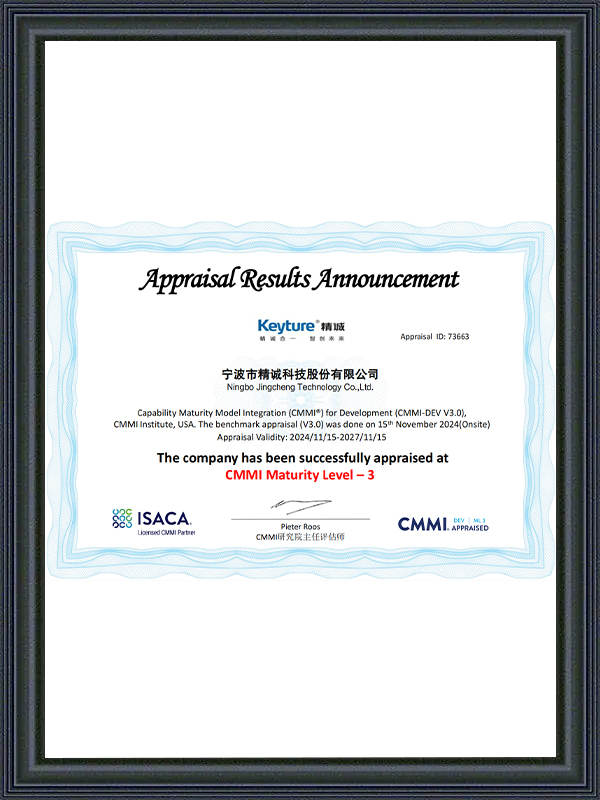
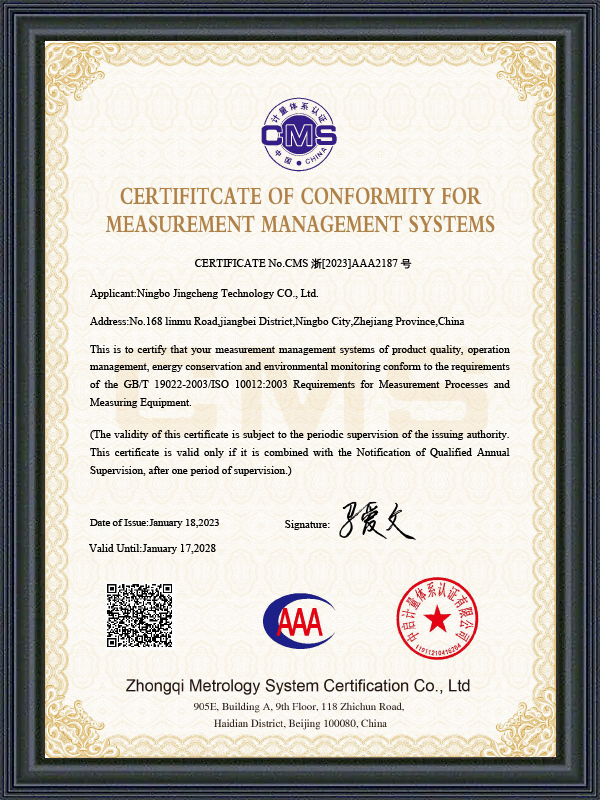
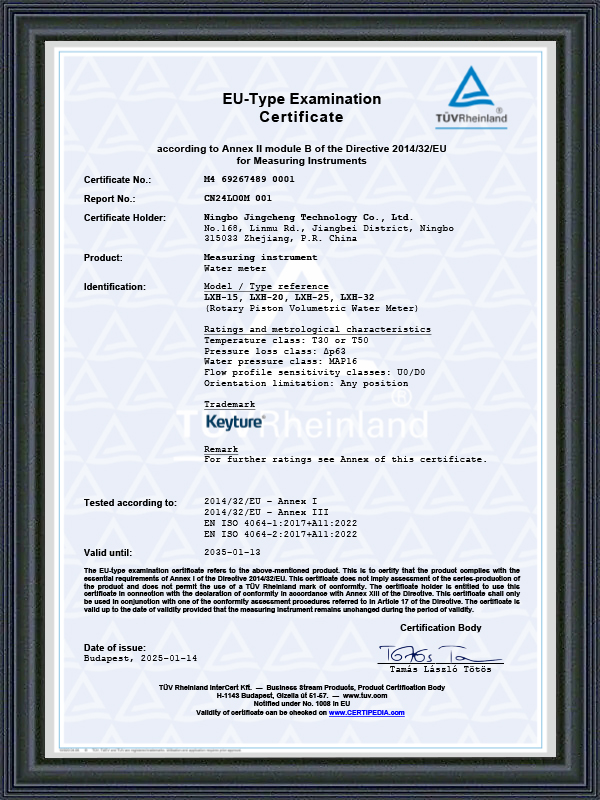
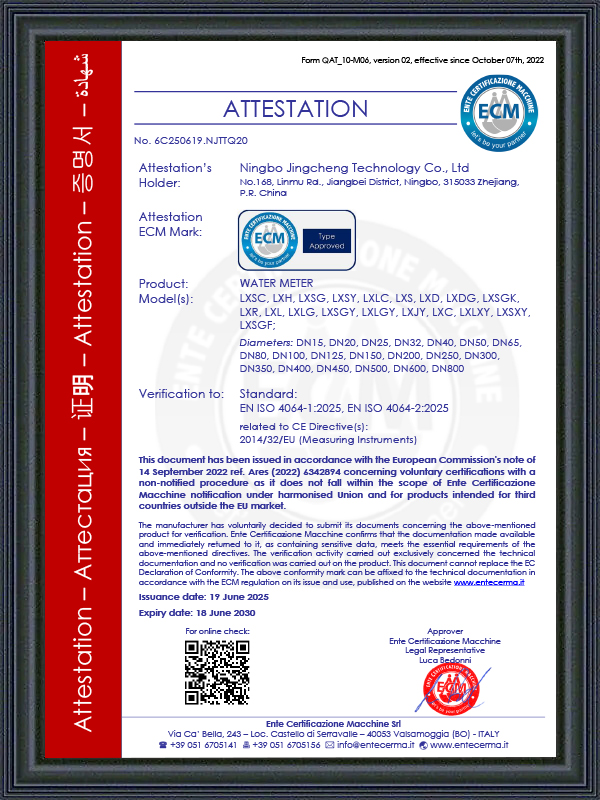
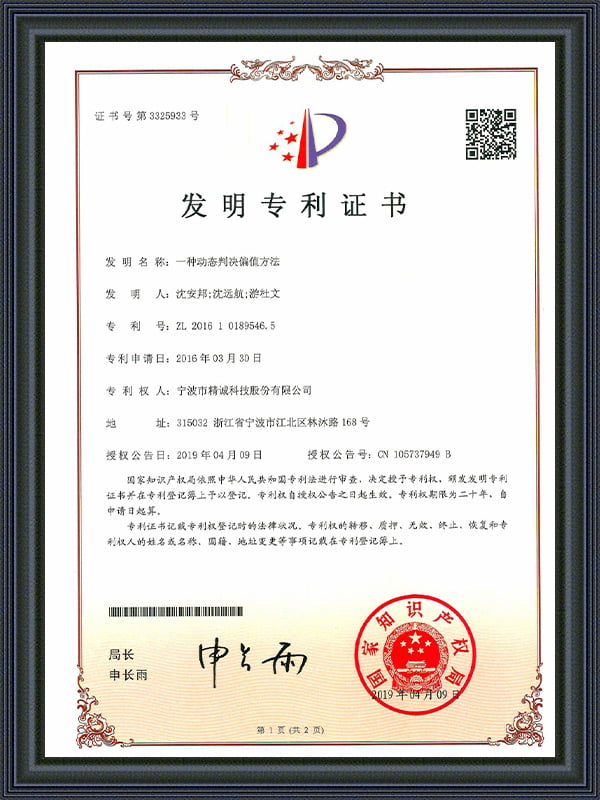
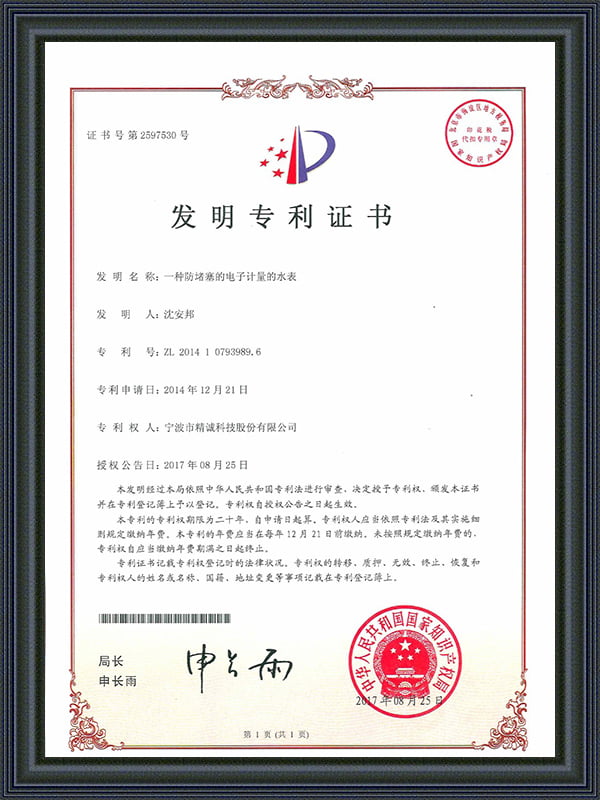
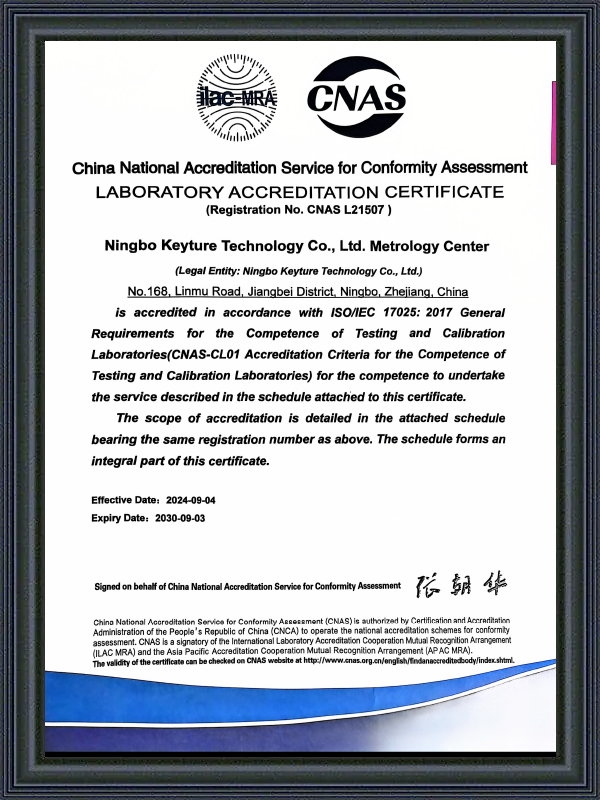

Two engineering topics define this meter: how a single jet drives the impeller, and how the polymer body is designed to hold pressure for years.
Water enters through a polymer strainer and is accelerated by a single tangential nozzle onto the vane wheel. Because the chamber, nozzle and impeller seat are moulded features, their dimensions are controlled by the tool rather than by machining. This gives excellent repeatability, and the calibration screw or flow-adjustment vane compensates for the small remaining variation.
The chamber is a sealed cartridge fitted into the body, with a magnetic coupling to the dry register. A single jet design needs little internal volume, so the moulded body can be small and light. As with all single jet meters, horizontal installation and a short straight pipe upstream are required to keep the impeller seated and the flow profile stable.
Plastics are viscoelastic: under sustained pressure they slowly deform, a behaviour called creep, and their strength falls as temperature rises. The body is therefore designed with uniform wall thickness, generous radii and reinforcing ribs, and is made from glass-fibre-filled polymer to raise stiffness and reduce creep. Finite-element analysis predicts stress at the nozzle, flange and thread roots, and prototypes are burst-tested to confirm margin.
Threaded connections are the most vulnerable point. Instead of moulding threads directly, most meters use brass or high-strength polymer tailpieces and nuts that clamp onto flat sealing faces with gaskets. This transfers installation torque to the connector and not the body. The result is a polymer meter that holds 10 bar working pressure for the full verification period when installed correctly and kept below 40 °C.
Measured performance data for the plastic body single jet water meter. Use these charts to confirm pressure loss, accuracy and installation dimensions before specifying.
Figure 1 — Head loss curve (MPa vs. flow m³/h)
The chart shows pressure loss across the plastic body single jet meter at DN15 and DN20. The compact nozzle chamber produces a slightly steeper curve than a multi jet meter, but loss remains at or below 0.1 MPa at Q3, which is acceptable for normal mains pressure.
Figure 2 — Accuracy error curve (Class 2, R80, Q1–Q4)
The error curve has the characteristic single jet shape: a small positive plateau in the middle of the range and a gentle drift negative toward overload. Moulded chamber repeatability keeps batch-to-batch variation small, so the curve stays inside ±5% in the lower zone and ±2% in the upper zone.
Figure 3 — Installation dimensions (L × H × B × D)
| Size | L (mm) | H (mm) | B (mm) | D (thread) |
|---|---|---|---|---|
| DN15 | 165 | 88 | 76 | G3/4" |
| DN20 | 190 | 92 | 78 | G1" |
Dimensions are for reference and exclude tailpieces. Confirm exact values with our engineering team before installation design.
Material choice shapes price, life and installation conditions. This table compares a polymer body with brass and with stainless steel.
| Design Feature | Plastic (Polymer) | Brass | Stainless Steel |
|---|---|---|---|
| Unit purchase cost | Lowest | Moderate | Highest |
| Weight | Lightest | Heavy | Heavy |
| Corrosion resistance | Immune | Good — DZR advised | Excellent |
| Lead content | None | Lead-reduced or DZR required | None |
| Maximum water temperature | 40 °C | 90 °C | 90 °C |
| Pressure and impact strength | Moderate | High | High |
| Refurbishment | Sealed for life | Refurbishable | Refurbishable |
| Best application | Cold water, new-build, tenders | General residential | Aggressive water, premium |
This comparison is indicative. Actual performance depends on climate, installation conditions and the specific product configuration. Contact our engineers for application-specific guidance.
Premium quality
since 2002
Coming From China, Marketing To The World
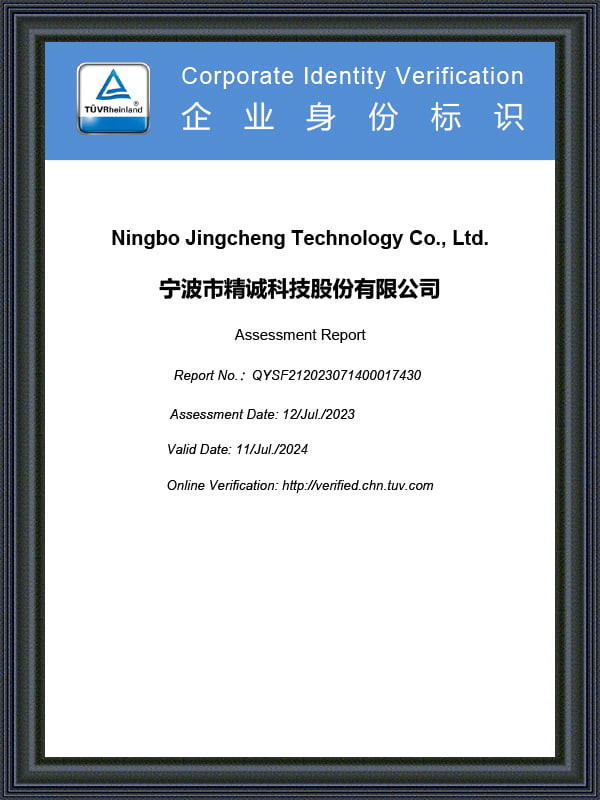
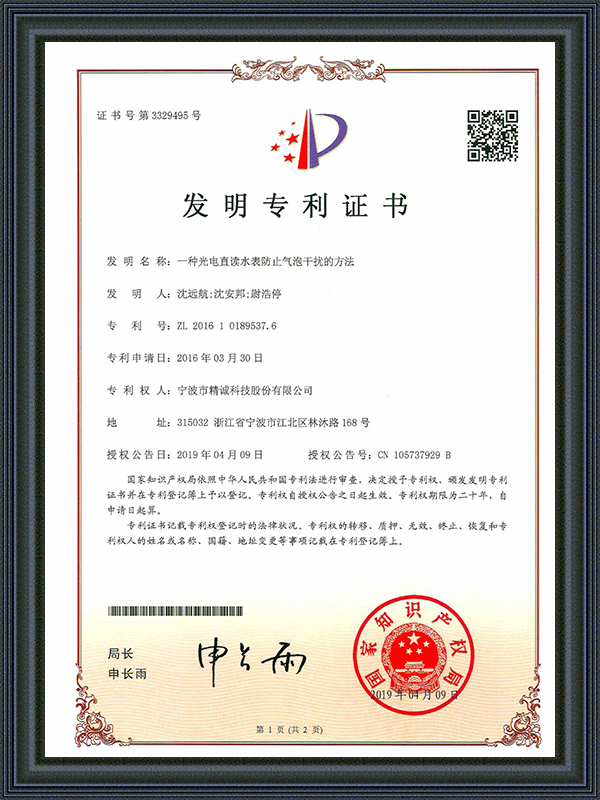
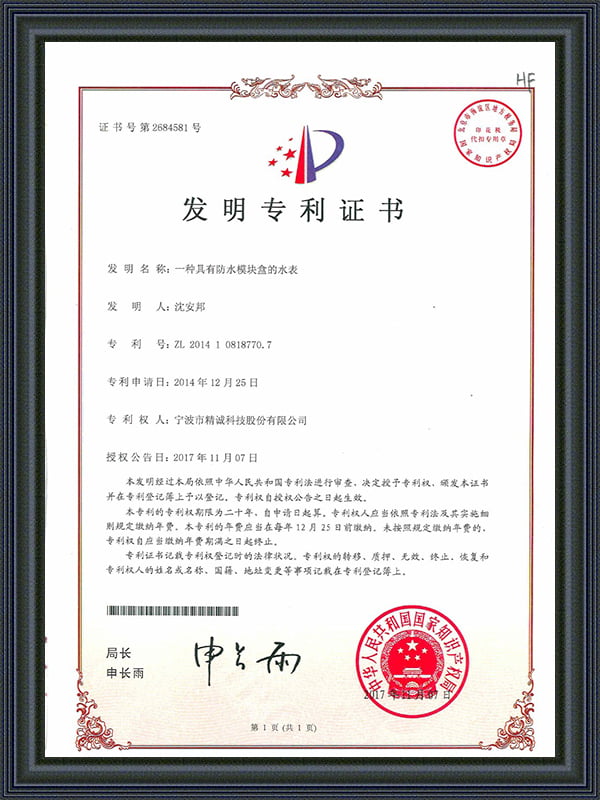
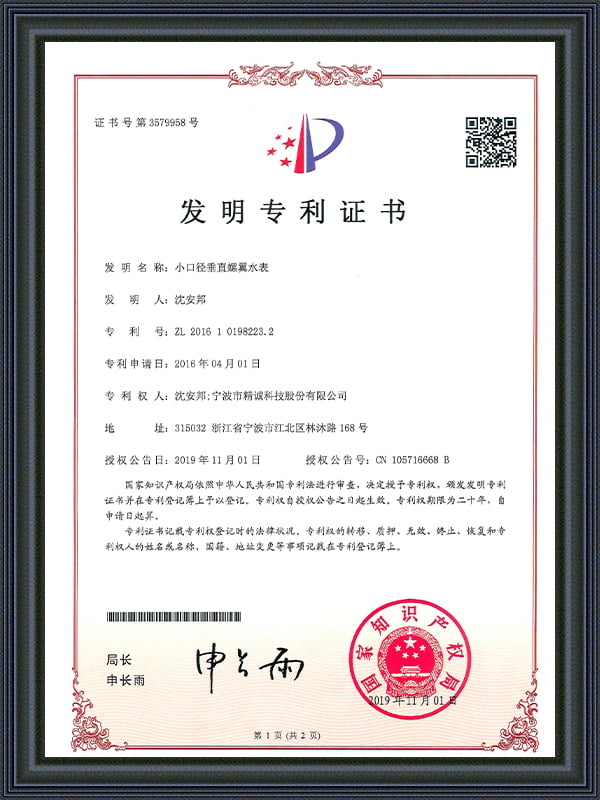
Keyture Meter is located in Picturesque Jiangbei Investment Park, NINGBO, CHINA. It is a comprehensive high-tech China Plastic Body Single Jet Water Meter Manufacturers and Custom Plastic Body Single Jet Water Meter Factory that integrates scientific research & development, production, sales, and service. Established in 2002 as a manufacturer and exporter of water meters for more than 22 years. The factory covers an area of 40 acres (30,000 square meters), 200 staff, 100+ types of products, product capacity of 5 million per year. Its product range covers single jet, multi-jet, volumetric piston type, Woltman type, IC card intelligent water meter, remote control water meter, optoelectrical reading direct remote control water meter...
Yearly production capacity
Production Area
Works and inspectors
Production experience
Excellent product with exquisite craftsmanship
Customization
We have a strong R&D team, and we can develop and produce products according to the drawings or samples the customers offered.
Cost
We are a professional manufacturer and also have our own processing machinery. So we can offer good prices and good products directly.
Quality
We have our own testing lab and advanced and complete inspection equipment, which can ensure the quality of the products.
Service
We focus on developing high-quality products for top-end markets. Our products are in line with international standards, and are mainly exported to Europe, America, Africa, Asia and other destinations around the world.
Capacity
Our annual production capacity is over 5 million units. We can meet the needs of different customers with different purchase quantities.
Shipment
We are about 35 kilometers away from Ningbo Port. It is very convenient and efficient to ship goods to any other countries.
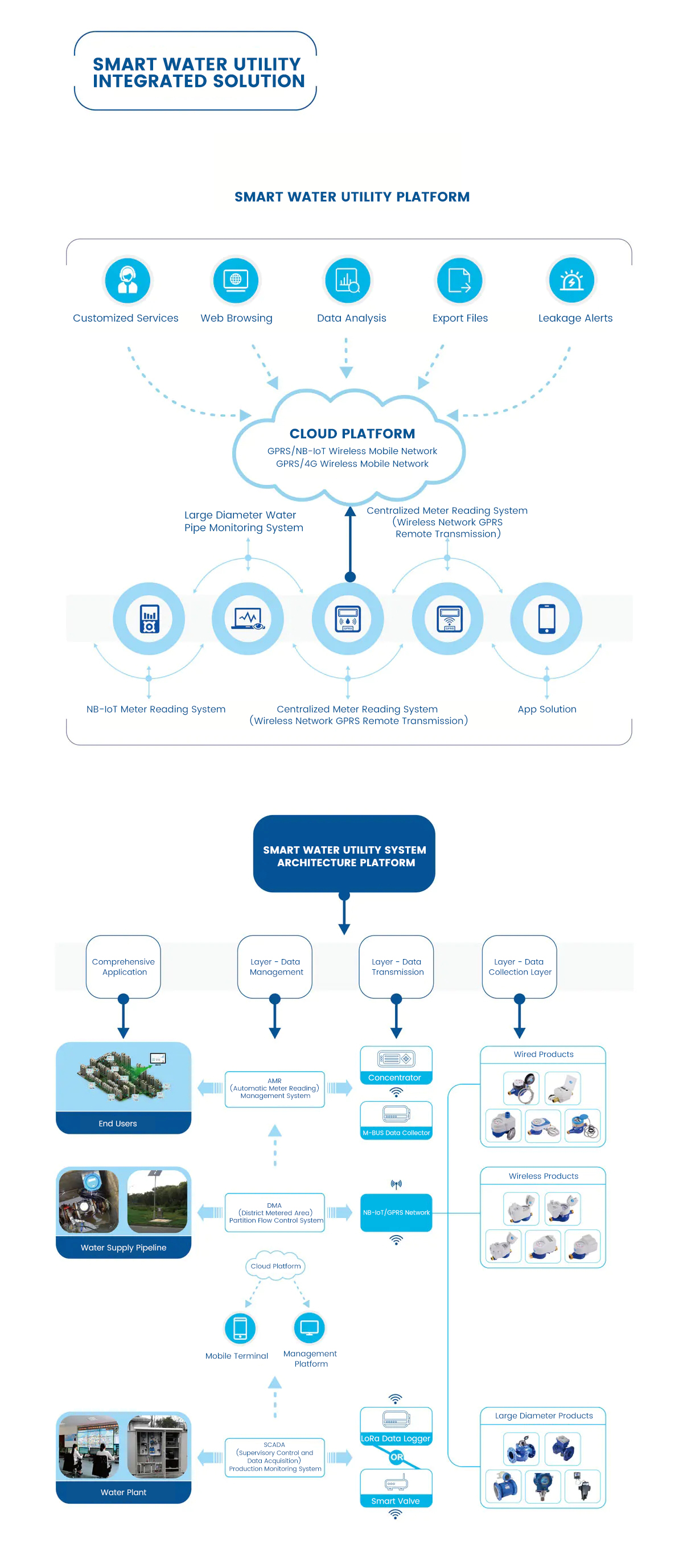
From mechanical meters to smart AMR/AMI systems — we provide end-to-end water metering solutions tailored to your project.
Best where price, weight and corrosion immunity matter and conditions are cold, clean and protected.
Install the meter horizontally with the register facing upward and the moulded arrow in line with the flow. A single jet is orientation-sensitive, and tilting the meter shifts the error curve. Use a spirit level when fixing, and keep at least 10 × DN of straight pipe upstream where possible.
Do not over-tighten. Hand-tighten the nuts and finish with a quarter turn, using the supplied gaskets. Never use pipe wrenches on the body, since plastic can crack under concentrated force, and avoid thread tape on the sealing faces of the tailpieces.
Keep the meter out of direct sunlight, away from hot pipes and protected from heavy loads. Use a meter box with a lid, and avoid placing the meter near boilers or steam lines. Flush the line before fitting to protect the strainer and impeller.
The plastic body single jet meter is a sealed unit with no serviceable parts. Maintenance consists of reading the dial, checking the unions for leaks and keeping the meter box clean and dry. If the dial becomes cloudy or the pointer stops, the meter should be replaced rather than opened.
Typical service life is 6 to 8 years in cold, clean water — matching most regulatory replacement periods. In warm climates, with exposure to sun or water above 30 °C, polymer ageing accelerates and the replacement cycle should be shortened.
At end of life, the meter is recycled as plastic, with metal tailpieces separated. For high-volume programmes, a returned-meter sampling plan can verify that accuracy remains within limits and support decisions on extending the interval.
Yes. Accuracy depends on the measuring chamber and impeller, which are the same in principle. A plastic body meter meets the same Class 2 limits under ISO 4064 / OIML R49. The body material affects durability, weight and cost, not metrological class.
Polymer grades are selected and tested for potable water contact and can be supplied with NSF/ANSI 61, WRAS, KTW or ACS certificates. Because there is no lead or copper, there are no metal leaching concerns.
The standard plastic body meter is designed for cold water up to 40 °C. Higher temperatures soften and creep the polymer. For hot water, please choose a metal-bodied hot water meter.
Yes. The standard version is rated for 10 bar working pressure, and 16 bar versions are available. The body is burst-tested at multiples of working pressure and endurance-tested at elevated temperature.
Prolonged ultraviolet exposure can degrade ordinary polymers. Install the meter in a shaded meter box or choose a UV-stabilised grade for exposed locations. Indoor and covered installations are not affected.
Six to eight years in cold, clean potable water is typical, which matches most regulatory verification periods. Hot climates, direct sun or high temperatures shorten life.
No, it is a sealed-for-life unit. This is how the low price is achieved. At the end of life, the meter is replaced and recycled. For refurbishable meters, consider a brass body.
Yes. Single jet meters are orientation-sensitive, and the standard calibration is for horizontal installation with the register facing upward. Vertical versions are not generally available for single jet designs.
Yes. A reed-switch pulse module can be fitted to the register for AMR compatibility, with 1 L or 10 L per pulse. Specify the pulse option at order stage.
Threaded connections G3/4" and G1" are supplied with brass or polymer tailpieces and nuts. Other thread standards can be provided on request. Tailpieces protect the plastic body from installation torque.
Water expanding on freezing can crack any meter body, plastic or metal. Plastic bodies are somewhat more tolerant than brass because they flex, but frost protection is still recommended. Insulate or drain the meter in freezing climates.
Polymer bodies are lighter, use less energy to produce and are fully recyclable. Lower weight reduces shipping emissions. Because they are replaced at end of life, plan recycling streams for the plastic and metal parts.
Send us the size, quantity, climate and pressure rating. Our engineers will recommend the right plastic body single jet configuration, with price and lead time.

Address: No.168,LinMu Rd.,Zone B, Jiangbei investment Park, Ningbo, Zhejiang,China
Tel: +86-0574-83090480/+86-18892665118
Fax: +86-0574-83021045
Email: [email protected]
Web: https://www.keyturemeter.com/
Quick Links
Product
Mobile terminal
 Custom Plastic Body Single Jet Water Meter Manufacturers