English
 Español


Imagine you are managing a residential building where the old water meters are reaching the end of their service life. Half of the tenants ask about unclear readings, the maintenance team wants a meter that can be installed without special tools, and the building owner asks whether the solution can support future remote reading. The question "what is the most common residential water meter?" is usually the starting point for this kind of decision.
The direct answer is the positive displacement water meter, also known as a rotary piston or volumetric meter. This meter type measures each passing volume through a precisely machined chamber and a moving piston. It has been the default residential choice in North America for decades, and it is very widely used in apartments and single-house applications across Europe, South America and parts of Asia. In some regions, especially in Europe and Southeast Asia, the multi-jet velocity meter is equally common and may appear more frequently because it handles slightly dirty water better and keeps its accuracy over long replacement cycles.
This guide explains why displacement meters became the most common residential water meter technology, how they compare with multi-jet and smart alternatives, which installation and sizing parameters matter, and how to approach purchasing when your project needs a stable supply.
When procurement teams and property managers search for the most common residential water meter, they are usually trying to reduce risk, not just satisfy curiosity. Choosing a meter family used across thousands of installations gives practical advantages. Spare parts such as pistons, registers, lenses and valve inserts are easier to source because local distributors stock them in higher volume. Installers are already trained on standard threads and slot dimensions. Replacement cycles are documented, so maintenance planning is simpler. And because high-volume production brings down unit cost, the most common meter type is normally the most budget-friendly option that still meets metering regulations.
There is another reason this topic matters. A meter is not just a pipe fitting; it is a revenue instrument. For a utility or a building owner, a meter that over-reads creates complaints, while a meter that under-reads quietly reduces income. The "most common" type has reached a mature balance between accuracy and cost. That does not mean it is always the right answer, but it is the correct baseline against which every alternative should be measured.
The technical challenge of residential metering is the wide flow range. A household can use only a few litres per hour in a slow drip, but more than a thousand litres per hour with a garden hose. A residential meter therefore needs a high turndown ratio, good low-flow sensitivity and a reasonable pressure drop at high demand. These requirements explain why the piston-based displacement meter occupies the number-one position in many markets.
A positive displacement meter contains a chamber with a very precise internal volume. Inside that chamber, a piston or disk moves in a fixed cycle. Each revolution pushes a defined volume of water from inlet to outlet. The meter mechanism counts the revolutions, and the total volume can be displayed mechanically on a register or transmitted as an electronic pulse.
The key word is "volume". Unlike velocity meters, which infer consumption from the speed of the water, a displacement meter measures water directly. This is why it performs extremely well at low flow. A typical 15 mm household piston meter can start registering meaningful consumption at a flow rate of 15 L/h or lower when it is properly selected, while a conventional single-jet meter might record only a portion of that amount. In real terms, a displacement meter can capture small leakages that would otherwise go unmeasured and unpaid.
At the residential level, typical models include the KM05-08 rotary piston volumetric water meter and the KM05-11 dry-type rotary piston volumetric meter for UK-style household installations. These meters are suited to clean, cold water networks where small-flow accuracy is the priority. Many modern displacement meters can begin registering at a low startup flow rate, which is one reason they are also used for leak detection projects.
There are, however, limitations. Displacement meters have moving parts running inside a narrow chamber. If the water contains sand, rust flakes or scale, the piston can wear faster. A built-in strainer is necessary, and the filter basket should be cleaned on a regular schedule. In some older pipelines with poor water quality, a velocity meter is actually the safer choice. This is one reason why the answer to "what is the most common residential water meter?" is not identical in every country.
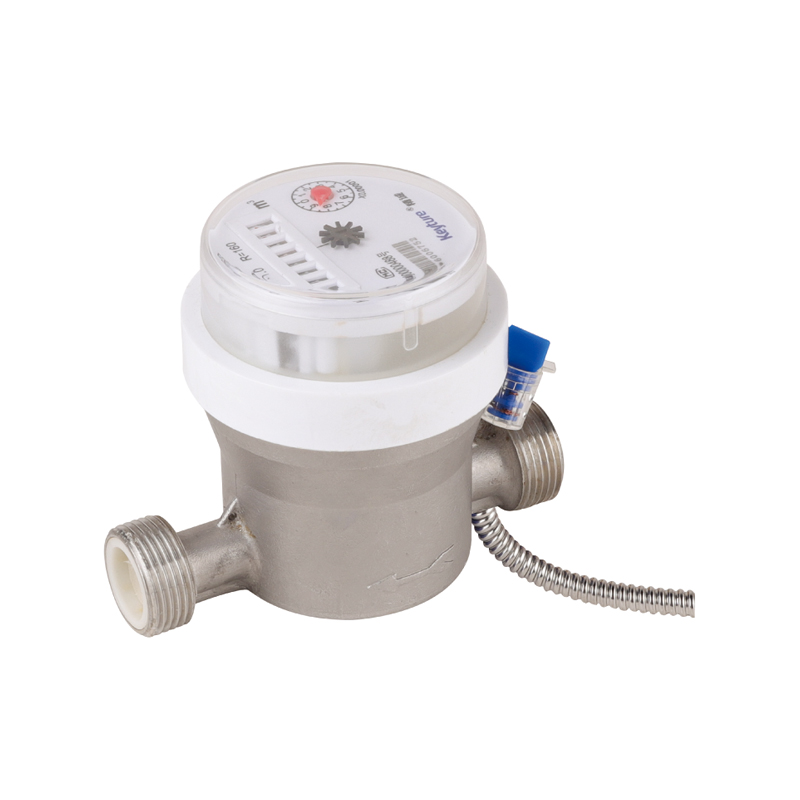
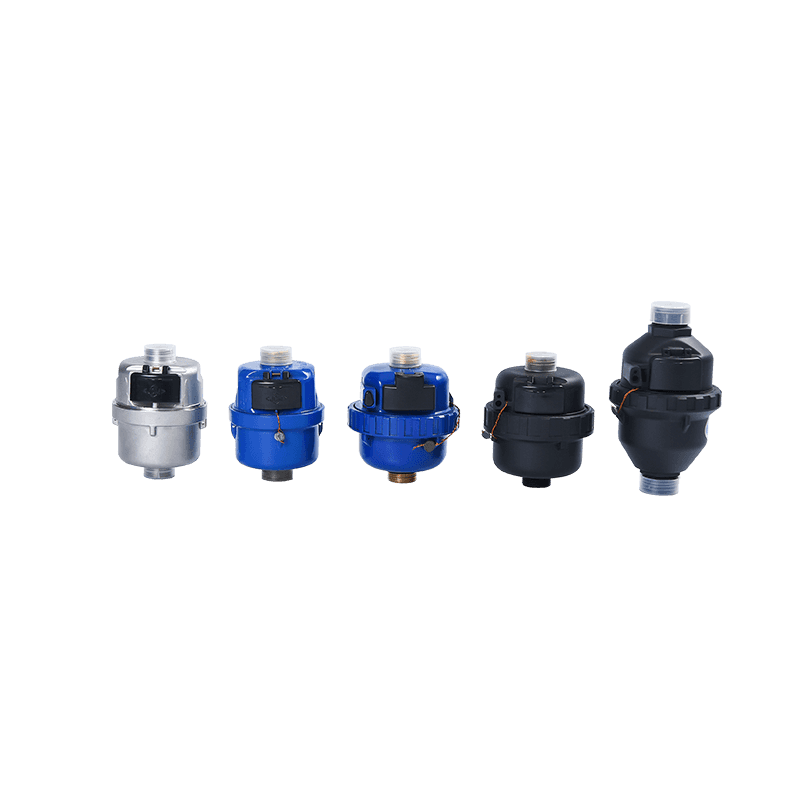 Rotary Piston Volumetric Cold Water Meter for Residential UseThis volumetric meter suits households needing high precision and reliable low-flow measurement. Its piston design resists wear from grit and particles, and the sealed register keeps readings clear, making it a dependable option for residential pipelines.View Product →
A multi-jet velocity meter does not measure volume directly. It accelerates water tangentially through several ports, making an impeller spin. The rotation speed is converted into a flow value. Multi-jet meters are widely used in residential and light commercial applications because their design is robust and their internal works can be replaced without removing the meter body from the pipeline.
In many European and Latin American markets, the multi-jet dry-type meter is the most common residential water meter. Water quality, maintenance habits and local water codes explain this difference. A multi-jet meter tolerates moderate solids better than a piston meter because the impeller has more clearance and the magnetic drive is less sensitive to small particles. When accuracy begins to drift, a maintenance crew can replace the measuring insert quickly, which is cheap and fast.
The flow range of a domestic multi-jet meter, for example a DN15 with Q3=2.5 m³/h at R160, starts from a Q1 value of about 16 L/h and covers the normal household range easily. That is close to a piston meter in most practical cases, though slightly weaker at the very bottom of the range. For the average resident, the difference is not visible in monthly bills; it matters mainly when you are trying to reduce non-revenue water or monitor a known leak problem.
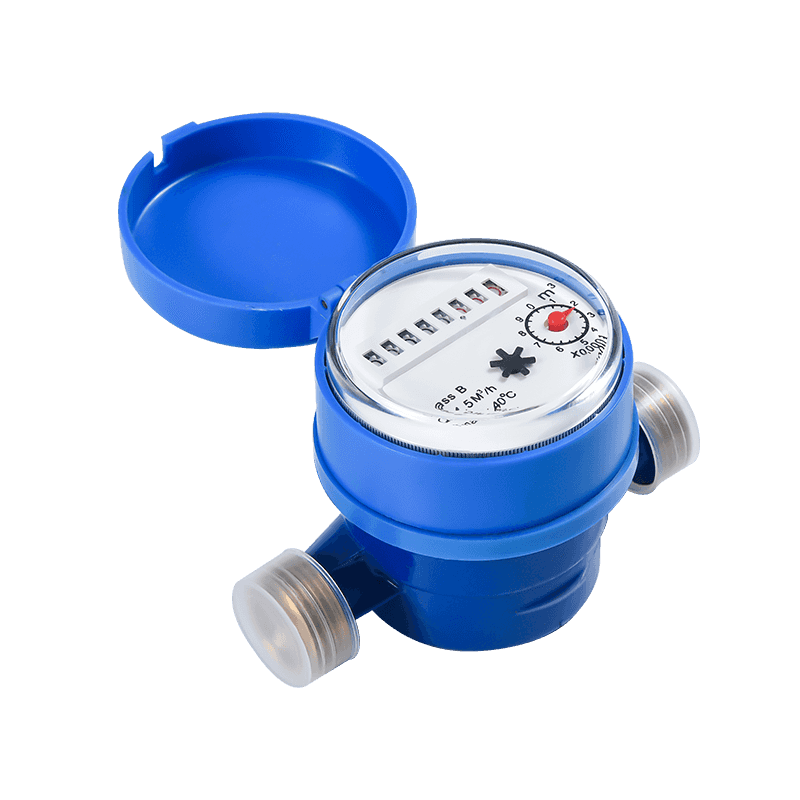
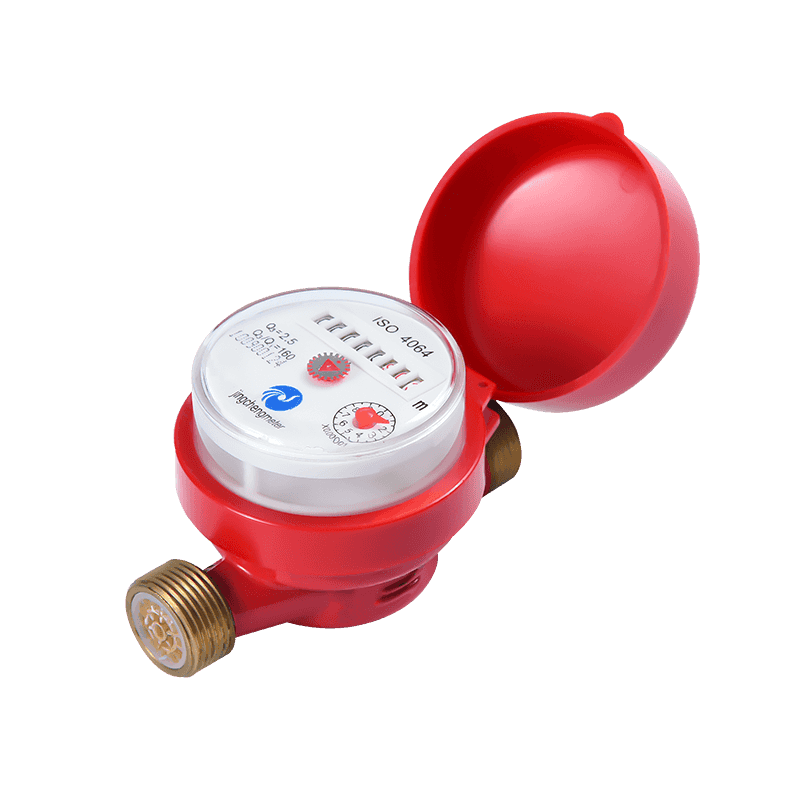
The KM0501 domestic multi-jet dry-type cold water meter is a representative example in this category. Its key advantages are an aluminium-sealed register, good corrosion resistance and a removable measuring insert. The KM0503 and KM0507 versions offer plastic bodies at a lower cost, while the KM0512 and KM0521 single-jet meters provide a compact alternative when the installation space is limited.
If your network carries water that may contain small particles, or if local maintenance teams are used to cartridge replacement, the multi-jet family may actually be the more common and practical choice in your region.
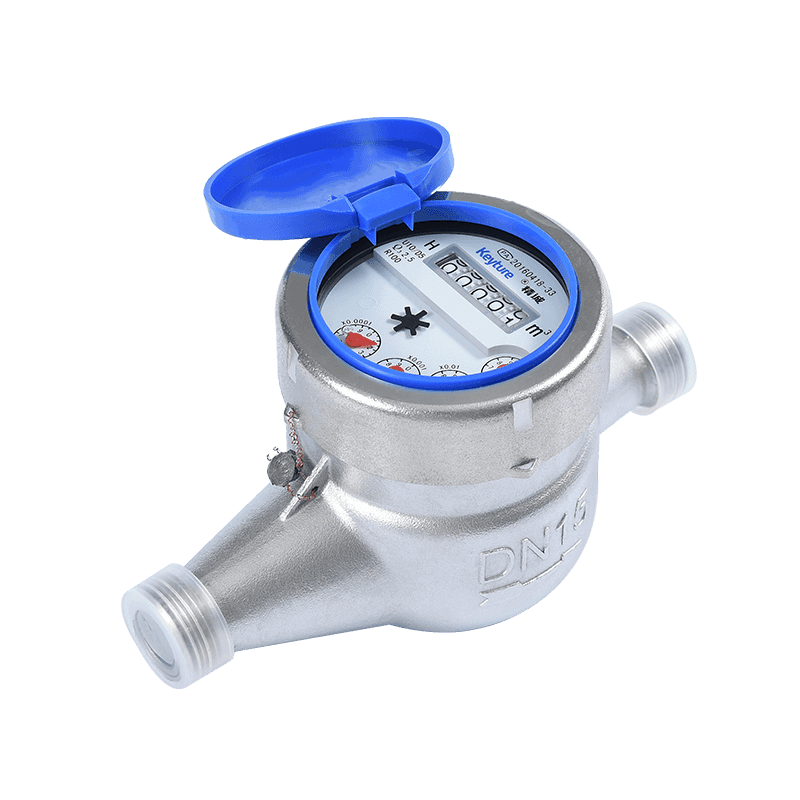
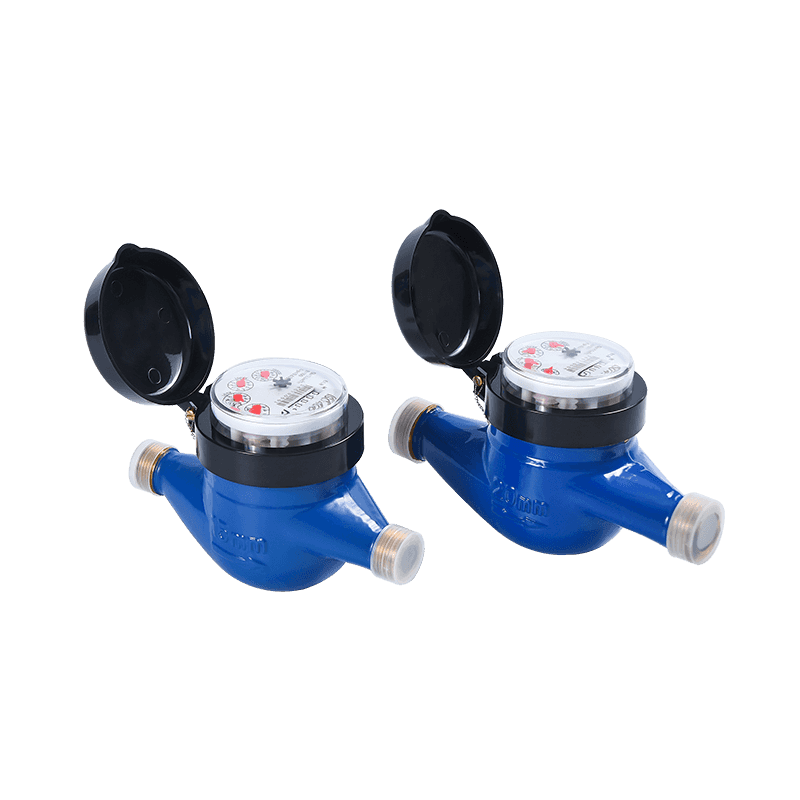 Domestic Multi-Jet Dry Type Brass Body Water MeterThis multi-jet meter offers a practical alternative for networks with particles or where cartridge replacement is preferred. Dry register and magnetic drive ensure long-term clarity and tamper resistance, with brass body options covering DN15–DN50.View Product →
The following table compares the meter families most likely to appear in residential projects. It is not a simple ranking table; the practical winner depends on water quality, installation orientation, regulation and budget.
| Meter Type | Measurement Principle | Typical Sizes | Low-Flow Behaviour | Pressure Loss | Typical Lifespan |
|---|---|---|---|---|---|
| Positive displacement / rotary piston | Volumetric chamber with piston | DN15, DN20 | Excellent | Medium | 10 to 15 years |
| Multi-jet velocity | Multiple tangential jets + impeller | DN15, DN20 | Good | Low | 10 to 15 years |
| Single-jet velocity | Single tangential jet + impeller | DN15, DN20 | Moderate | Low | 10 to 12 years |
| Ultrasonic | Transit-time acoustic measurement | DN15 to DN40 | Excellent | Very low | 12 to 15 years |
| Prepaid smart meter | Mechanical or electronic base with valve | DN15, DN20 | Depends on base meter | Low | 8 to 12 years |
The table shows why displacement meters and multi-jet meters are the two strongest contestants for the title of "most common residential water meter". Ultrasonic meters are entering the household segment because they remove wear and enable wireless reading, but the price gap is still significant. Smart prepaid meters are a functional layer on top of one of these base technologies, rather than a completely separate measuring principle.
The visible part of a residential water meter is the register. It can use a wet dial, a dry dial or a semi-liquid sealed dial. The difference is not only about readability; it also determines how the meter responds to temperature, humidity and field maintenance.
A wet dial means the register gears are in contact with the water. This design is simple and low-cost, and it avoids condensation because the dial is naturally wet inside. It works well in cold climates where dry registers tend to fog. The downside is that with dirty water the dial becomes harder to read over time.
A dry dial isolates the gears from the water with a transparent or opaque capsule. It gives a cleaner, longer-lasting display. Dry-type meters are preferred in European and Middle Eastern projects, where readability after several years is a explicit requirement. The magnetic coupling inside the register may attract metallic particles from poor water quality, so good designs add magnetic shielding or use an aluminium-sealed case.
A semi-liquid sealed dial is a compromise. The counter housing is filled with a protective liquid that reduces condensation and friction. This option is often chosen for outdoor meter boxes with high humidity, where a wet dial would fog and a dry dial might still get moisture inside the capsule.
The meter shell material is the second major decision. The common options are:
When you compare quotes, check what the register and main body are made of, not just the final price. A project with outdoor installation in a warm climate may justify an IP68 waterproof meter, while a sheltered indoor installation can use a standard IP65 model. For buildings with a hot water supply loop, specify a hot water meter with a brass or stainless steel body, because standard cold-water meters are usually rated up to 30 °C. For potable water projects with stainless steel pipework, the 304 stainless steel drinking water meter series is a strong fit, including the KM0403 dry-type model and the KM0405 wireless remote version.
Residential meters are most commonly 15 mm, 20 mm or 25 mm in nominal diameter. In the North American system, the standard household size is often called 5/8 inch by 3/4 inch, which corresponds to a 15 mm meter body with 20 mm connection threads. In Europe, DN15 is the dominant choice for apartments, while DN20 may be used for houses with a large instantaneous demand, a water softener or a private garden irrigation system.
Before selecting a meter, look at the Q3 value and the R ratio. For a typical household, Q3 is usually 2.5 m³/h or 4.0 m³/h. The R ratio, also called the turndown ratio, defines the relationship between Q3 and the minimum flow Q1. A meter rated Q3=2.5 m³/h at R160 has a Q1 of 15.6 L/h. At R250, Q1 would be 10 L/h. The higher the R value, the better the meter can register small flows. Displacement meters usually achieve R160 or R250 at household sizes without electronic amplification.
Pressure loss is another critical number. At Q3, a residential mechanical meter should have a pressure loss below 0.63 bar, and typical values are in the range of 0.4 to 0.6 bar. A very high pressure loss can cause problems in tall apartment blocks or poorly pressurised networks. Ultrasonic meters tend to have the lowest pressure loss because they have no narrow chamber or impeller blocking the flow path.
Installation conditions matter just as much as flow rating. The following points are frequently missed during project planning:
For buyers, the safe approach is to request a datasheet covering Q1, Q2, Q3, Q4, the pressure loss curve, temperature range, installation orientation and weight. Simply specifying "DN15" is not enough to compare two meters from different factories.
The term "residential water meter" today includes not only mechanical meters but also electronic and smart models. The most common smart residential water meter is still based on a mechanical measuring element, with an added remote-reading module. This hybrid approach keeps the low-cost reliability of mechanical measurement and adds the ability to collect consumption data without entering the property.
There are several communication options to evaluate:
When decision makers ask whether smart meters are the "most common" residential water meter, the answer in 2026 is still mixed. Mechanical meters dominate in terms of absolute installed units, but in new installations the share of smart-ready meters is rising quickly. Countries with large utility networks increasingly specify NB-IoT or LoRa based smart water meters as a standard. In private residential projects, however, price sensitivity keeps the plain mechanical meter as the default.
A good middle path is a mechanical meter with a modular pulse output, which can be upgraded to remote reading later. The KM0102 wireless remote dry-type meter and the KM0206 dry-type wired remote meter with pulse output are examples of this approach. For projects that are ready to move to fully electronic metering, a household ultrasonic meter such as the KM07-01 offers high accuracy, no mechanical wear and a straight measurement channel that reduces pressure loss. The trade-off is cost: an ultrasonic meter can cost several times more than a basic mechanical meter, and its long-term reliability depends on battery quality, electronics shielding and the surrounding electromagnetic environment.
If you are designing a new smart water network and want accurate low-flow measurement at a lower price than ultrasonic, a prepaid meter with a positive displacement base is worth investigating. This is where the "most common" displacement technology and the "most requested" smart function can be combined into one housing.
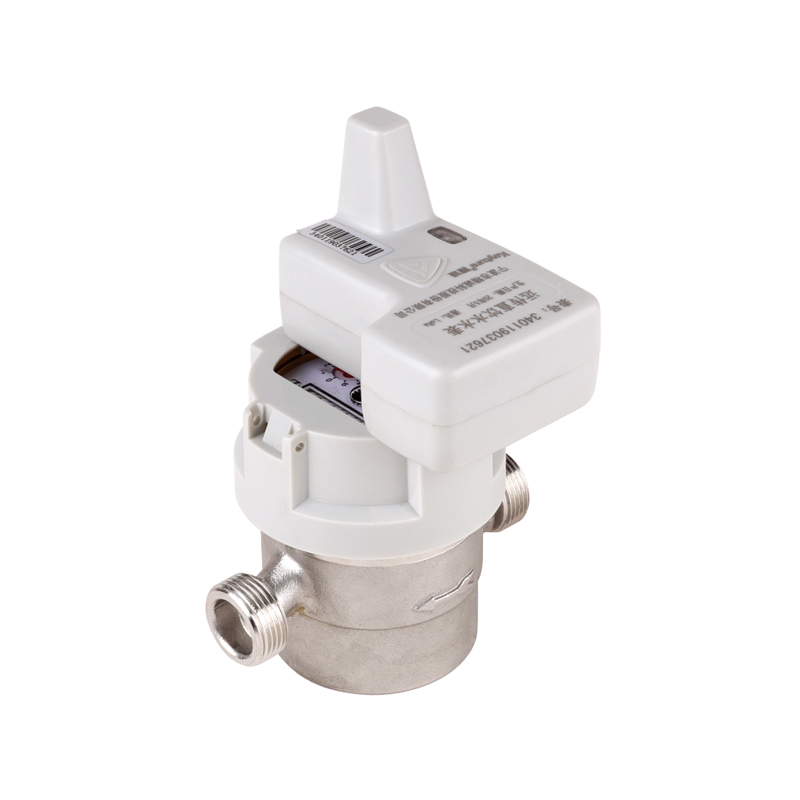
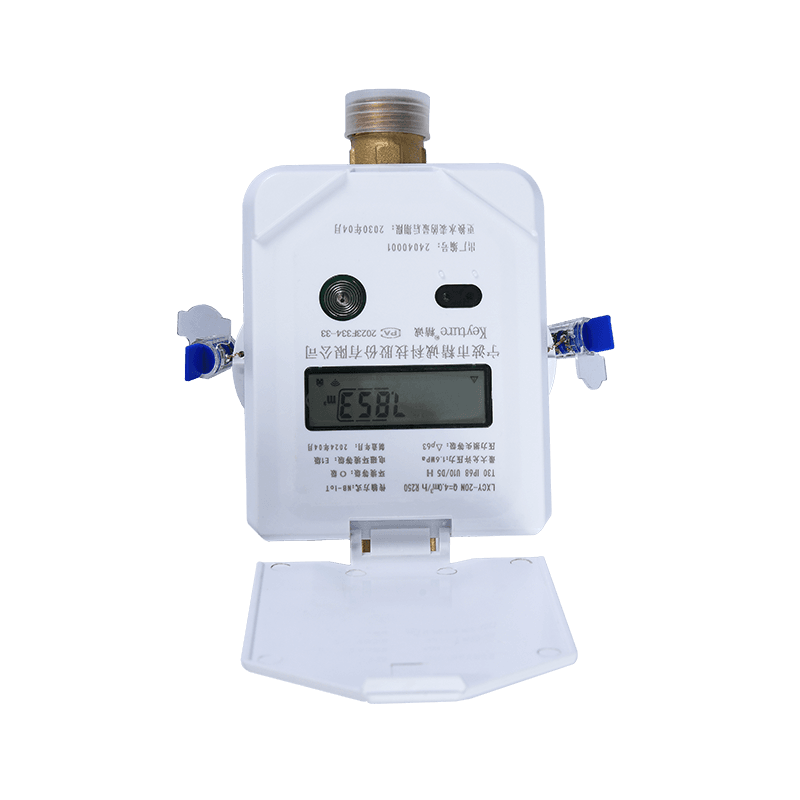 Domestic Ultrasonic Water Meter DN15–DN25 with Remote ReadingThis smart ultrasonic meter provides accurate low-flow measurement without moving parts, and it detects both forward and reverse flow. With IP68 protection and AMR-ready communication, it fits modern smart water networks at a lower cost than other ultrasonic options.View Product →
To make the selection process easier, we have summarised realistic project scenarios into the decision cards below. They reflect patterns we see as a water meter factory serving overseas residential projects.
A multi-jet dry-type meter in DN15 with a brass or plastic body gives the lowest ownership cost. The KM0501 and KM0515 are representative. This is why multi-jet is the most common residential water meter in many projects of this kind.
Wet-type or semi-liquid sealed registers survive humid boxes and dirty water better. The KM0505, KM0514 and KM0515 are practical options for maintenance-heavy networks.
A positive displacement meter such as the KM05-08 can detect flows as low as a few litres per hour, making it the most reliable tool for monitoring real-estate water loss.
A wireless or wired remote meter with a dry dial, such as the KM0102 or KM0206, can be read through existing infrastructure while keeping reliable mechanics.
IC-card and RF-card prepaid meters with a ball valve allow the operator to collect water fees in advance. For utilities that require open standards, the STS prepaid meter is the safer route.
304 stainless steel eliminates lead and dezincification risks. The KM0403, KM0404 and KM0405 drinkable-water meters are designed for clean, hygienic supply lines.
Cost is the final filter in almost every residential water meter project. The purchase price depends on the material and the level of sophistication:
The more important calculation is the cost over the meter's working life. A typical residential mechanical meter lasts 10 to 15 years, depending on water quality, installation location and flow patterns. During that period, the supplier should be able to ship registers, pistons, impellers, gaskets and strainer inserts. When a manufacturer also produces the meter mechanism and register in its own factory, after-sales uncertainty is reduced. This is one reason vertical manufacturing matters for buyers who manage thousands of meters.
Preventive maintenance for mechanical meters usually includes cleaning the strainer, inspecting the register seal and checking the reading accuracy against a test bench. For smart meters, the main cost items are the battery, the communication module and the valve. Some prepaid meters have a remote-controlled valve; the valve must be actuated regularly to avoid sticking. If the valve fails, the meter must be swapped even if the measuring parts still work correctly.
We also recommend looking at the failure-rate data in the product documentation. Honest suppliers will state the maximum permissible error at Q1 and Q4, the starting flow, and the test conditions. This data tells you more than a marketing claim of "high accuracy".
Q: What is the most common residential water meter in the world?
A: Positive displacement meters are the most common in North America and in projects that prioritise low-flow accuracy. Multi-jet velocity meters are equally or more common in Europe, Latin America and parts of Asia. Both are mechanical meter families with long track records in household installations.
Q: Are positive displacement and rotary piston water meters the same thing?
A: In practice, yes. Positive displacement is the broader category, and the rotary piston is the most common subtype used in residential cold-water meters.
Q: Which residential water meter size is used most often?
A: DN15 is the standard for apartments in almost all markets. DN20 is common for larger houses and properties with higher demand. In North America, the conventional size is often called 5/8 inch by 3/4 inch.
Q: Is a wet dial or dry dial water meter better?
A: It depends. A wet dial is cheaper and naturally resists condensation, but readability can degrade if the water is dirty. A dry dial keeps a clearer display and is preferred for most professional residential projects. In humid outdoor boxes, a semi-liquid sealed register is a reliable middle option.
Q: How long does a residential water meter last?
A: With clean water and a stable indoor environment, a mechanical meter typically remains accurate for 10 to 15 years. Smart meters may have a battery life of 6 to 12 years depending on communication frequency. Local regulations often set the legal replacement interval at 6 to 10 years.
Q: Are ultrasonic water meters more accurate than mechanical meters?
A: Ultrasonic meters have a wide measuring range and no moving parts, which solves the wear problem. At very low flows they can be accurate when properly calibrated, but the electronics must remain stable over time. The higher first cost means the decision depends on budget and the value of remote reading.
Q: What should I check when buying residential water meters in volume?
A: Check the metrological performance at Q1 and Q4, pressure loss, body and register material, filter design, valve type, warranty and spare parts availability. If remote reading is planned, also check the communication protocol and compatibility with your existing data platform.
Residential water metering is one of the most conservative parts of the water industry, but procurement decisions still have direct financial consequences. The most common residential water meter is common for a clear reason: it gives reliable accuracy at a price that a housing project can afford, whether that meter is a positive displacement or a multi-jet depending on the region.
As an exporter and manufacturer, we have spent more than two decades building mechanical meters, smart meters, ultrasonic meters and the components that go inside them. Our production site covers roughly 30,000 square metres and ships nearly five million meters per year. Because we also produce piston mechanisms, impellers, registers, valves and connectors in-house, we can support long-term projects with stable quality and spare part supply. If you want to review the details before sourcing, our factory background is a good place to start.
If you are evaluating meter suppliers for a residential project, we suggest asking the factory for the full specification, a sample for field testing and an accuracy test report. This will tell you far more than a brochure. Send us the working conditions of your site, and we can recommend a meter that fits both your technical requirements and your budget.


Address: No.168,LinMu Rd.,Zone B, Jiangbei investment Park, Ningbo, Zhejiang,China
Tel: +86-0574-83090480/+86-18892665118
Fax: +86-0574-83021045
Email: [email protected]
Web: https://www.keyturemeter.com/
Quick Links
Product
Mobile terminal
 Wholesale Potable Water Flow Meter Manufacturers