English
 Español


When a maintenance supervisor starts sourcing replacement water meters, the first question is rarely about brand. It is about type. Product catalogs list single-jet, multi-jet, Woltman, rotary piston, ultrasonic, electromagnetic, and many smart variants. The practical decision, however, can be narrowed down to three types of water meters: positive displacement (volumetric) meters, velocity meters, and electronic meters. The key is not which type is newer, but which measuring principle gives the repeatable result you need at the flow rates and pipe conditions you actually have.
Before choosing, it helps to see how the three categories differ in the way they measure flow. This comparison is based on general characteristics for cold, clean water.
| Type | Measurement principle | Common diameters | Typical strength | Main limitation |
|---|---|---|---|---|
| Positive displacement (volumetric) | Water fills and empties fixed chambers; each chamber volume is counted. | DN15 to DN25, some DN40 | High accuracy at low flow | Sensitive to particles; more moving parts |
| Velocity (jet/turbine) | Flow speed rotates an impeller or turbine; speed is converted into volume. | DN15 to DN50 for jets; DN50 to DN300 for Woltman | Broad flow range, lower cost per size | Accuracy can be affected by flow profile |
| Electronic (ultrasonic/electromagnetic) | Sound travel time or induced voltage is used to calculate flow. | DN15 to DN200 and above | No moving parts, low maintenance, data-ready | Higher initial cost; may need power source |
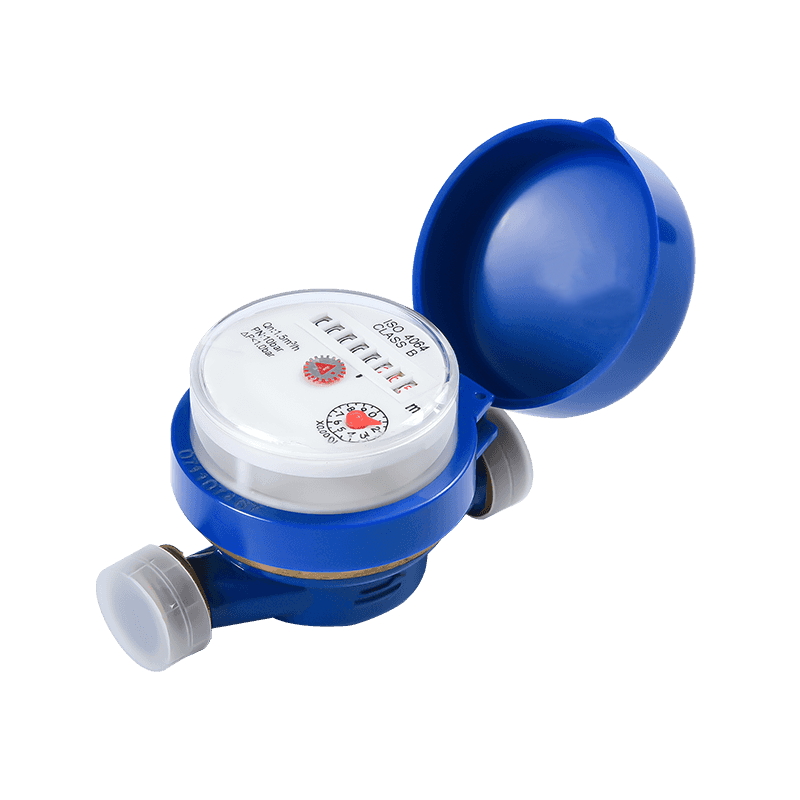
Positive displacement meters, also called volumetric meters, divide water into fixed-volume chambers. A rotating piston or oscillating piston moves as water enters and leaves each chamber. Because every complete cycle represents a known volume, this type is generally the most accurate at low and intermittent flows. That is why small-diameter domestic meters often use the rotary piston principle when the main concern is capturing leakage and nighttime consumption.
For a procurement team, the trade-off is maintenance. The measuring chamber has more moving parts than a turbine meter, so a positive displacement meter should be installed after adequate filtration or in a supply with consistently low turbidity. In many apartment buildings, rotary piston meters are the first choice for individual units.
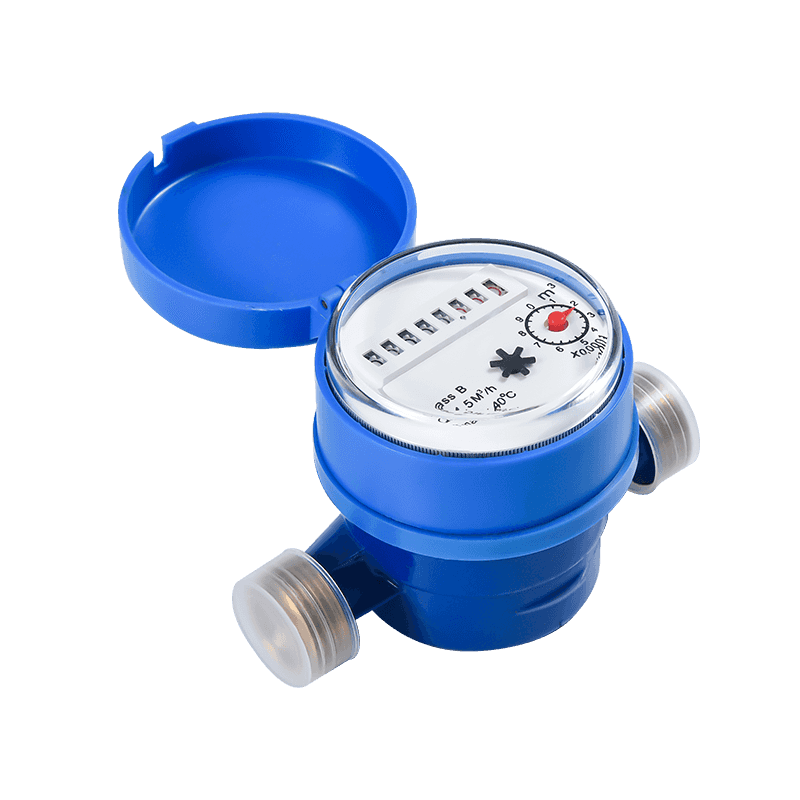
In the Keyture range, the KM0509 rotary piston meter uses a plastic body, dry-type register, and compact connection options. It is designed for DN15/DN20 cold water connections where stable low-flow measurement matters over years of service.
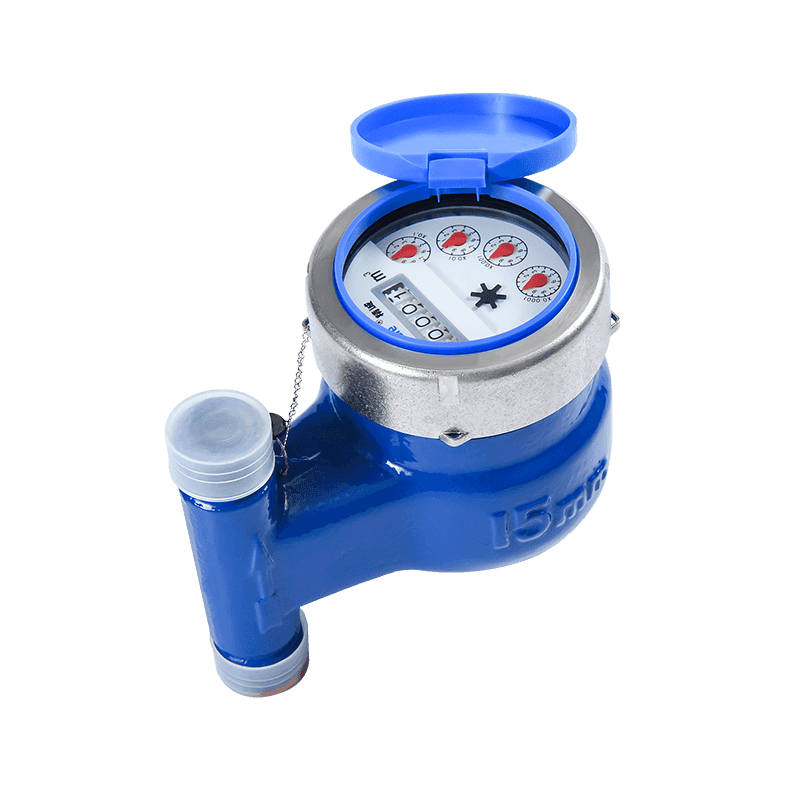
Velocity meters measure the speed of water moving through the meter and convert that speed into volume. They are divided into jet meters — single-jet and multi-jet — and turbine or Woltman meters.
A single-jet meter directs all flow through one nozzle against an impeller. The design is simple, cost efficient, and works well for moderate flows. A multi-jet meter has several inlet ports arranged around the impeller. Because the flow is distributed evenly, the rotor movement is more stable, and the meter keeps better accuracy across a wider flow range. For residential meters with pulse or remote reading, the multi-jet principle is a common base.
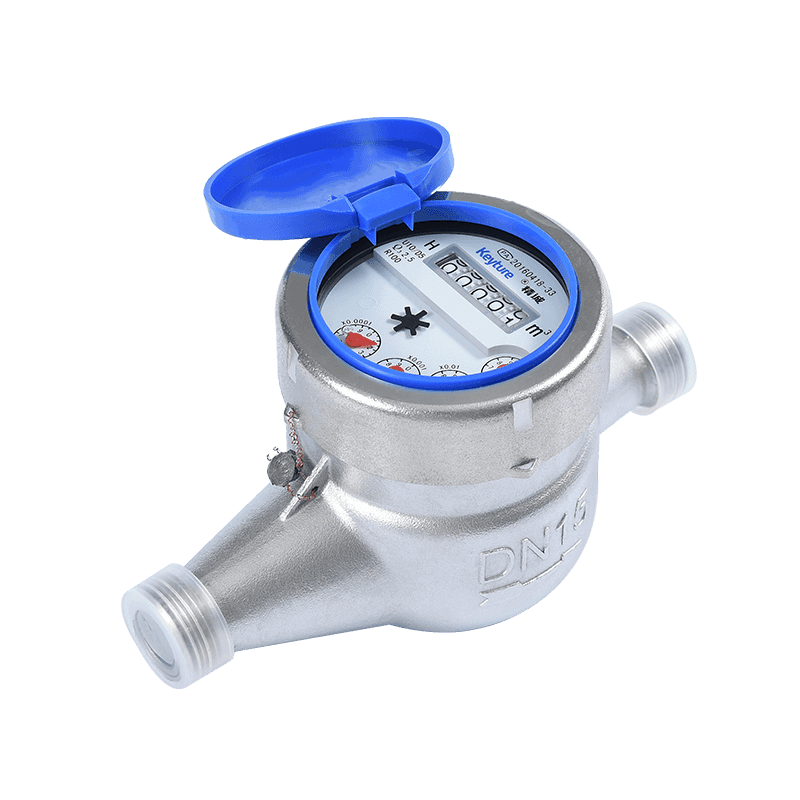
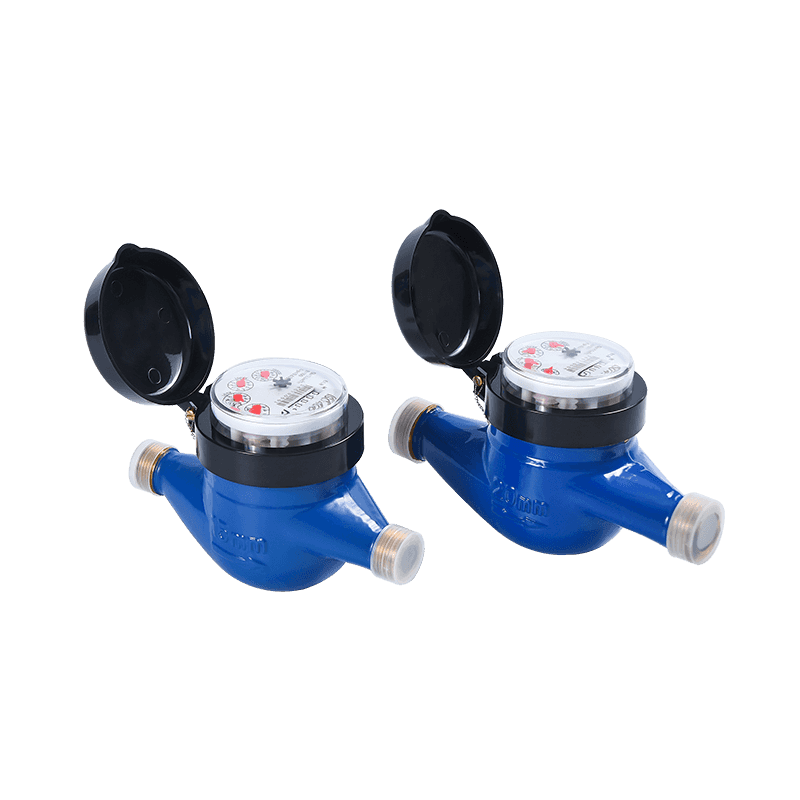 KM0501 Multi-Jet Dry Dial Cold Water Meter with Pulse OutputThis dry-dial multi-jet meter offers stable accuracy across residential flow ranges, with brass or iron body options and pulse output for basic remote reading in warm or humid settings.View Product →
The KM0501 is a dry-dial multi-jet meter with a brass or iron body option and can be ordered with pulse output for basic remote reading. The dry dial keeps condensation from fogging the register, which is especially useful in warm or humid environments.
For larger pipe sizes, velocity measurement is usually handled by a Woltman meter, also called a bulk meter. Water flows along the pipe axis and drives a turbine rotor at a speed proportional to flow velocity. Woltman meters cover DN50 to DN300 and above, making them a practical choice for apartment building inlets, irrigation mains, and industrial service lines. Their straight-through body means lower pressure loss, but they need sufficient straight pipe upstream and downstream to deliver accurate readings. Detachable Woltman designs are easier to inspect and repair, which is one reason many facility teams prefer them for large meters.
Electronic water meters replace moving mechanical elements with sensors. Two main principles are used in this group. Ultrasonic meters measure the difference in transit time between sound pulses sent upstream and downstream. Electromagnetic meters measure the voltage produced by a conductive fluid moving through a magnetic field. Both methods create no obstruction to flow and have no impeller or piston to wear out.
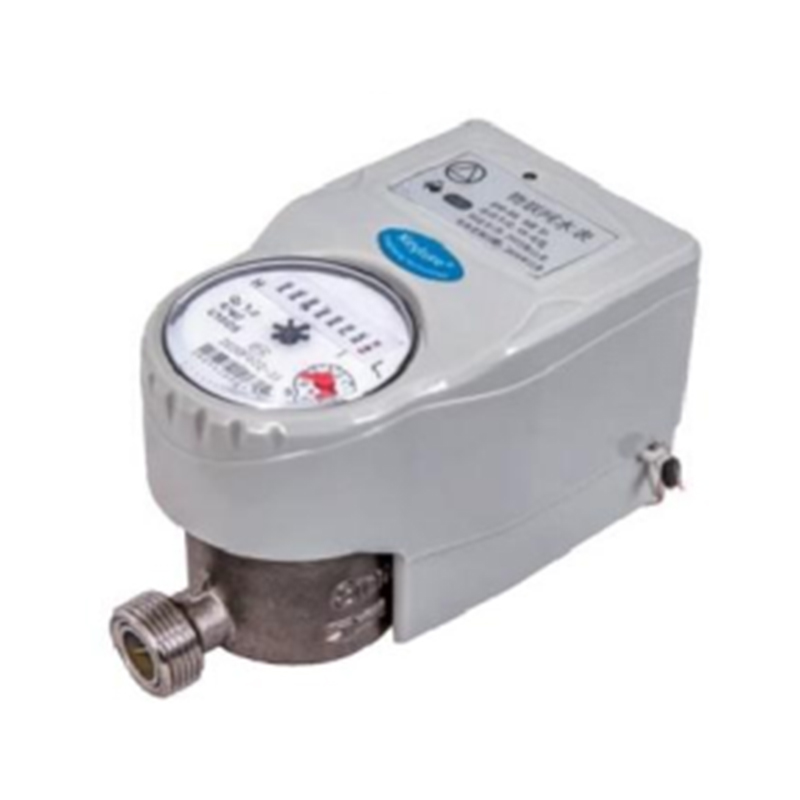
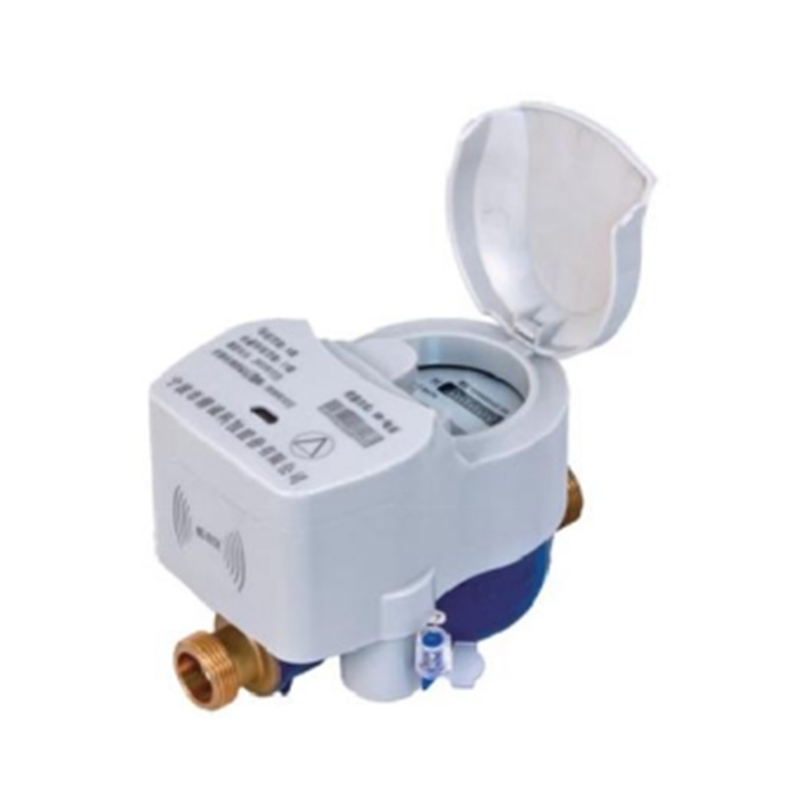
This third category is becoming the standard choice when remote reading, leak alarms, or data analysis are required. Because the meter outputs a digital signal, it can connect to NB-IoT, LoRaWAN, M-Bus, RS485, or a pulse transmitter. That makes it easier to build a reading network without visiting every meter.
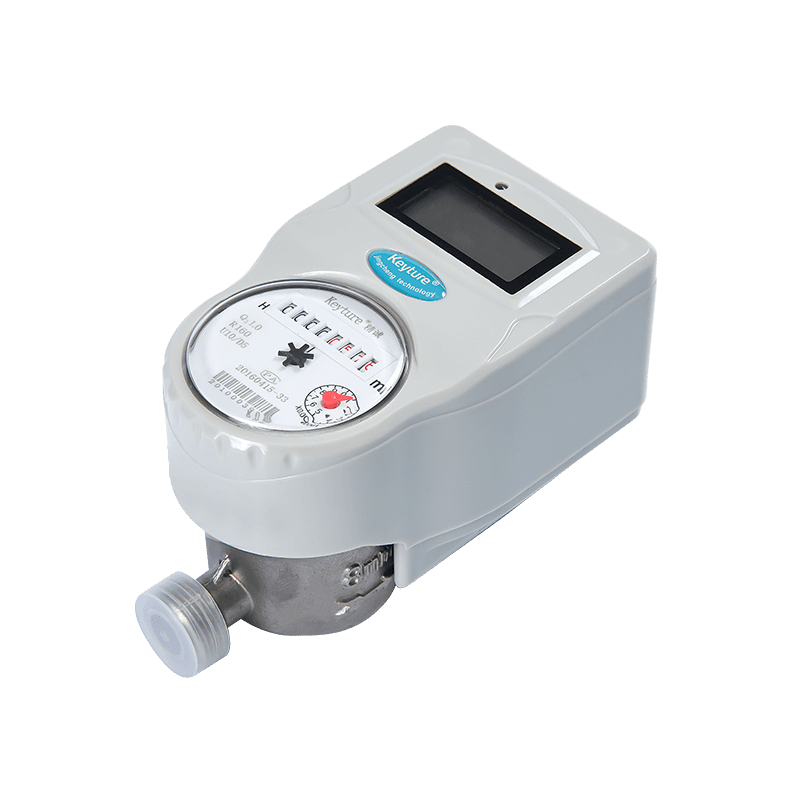
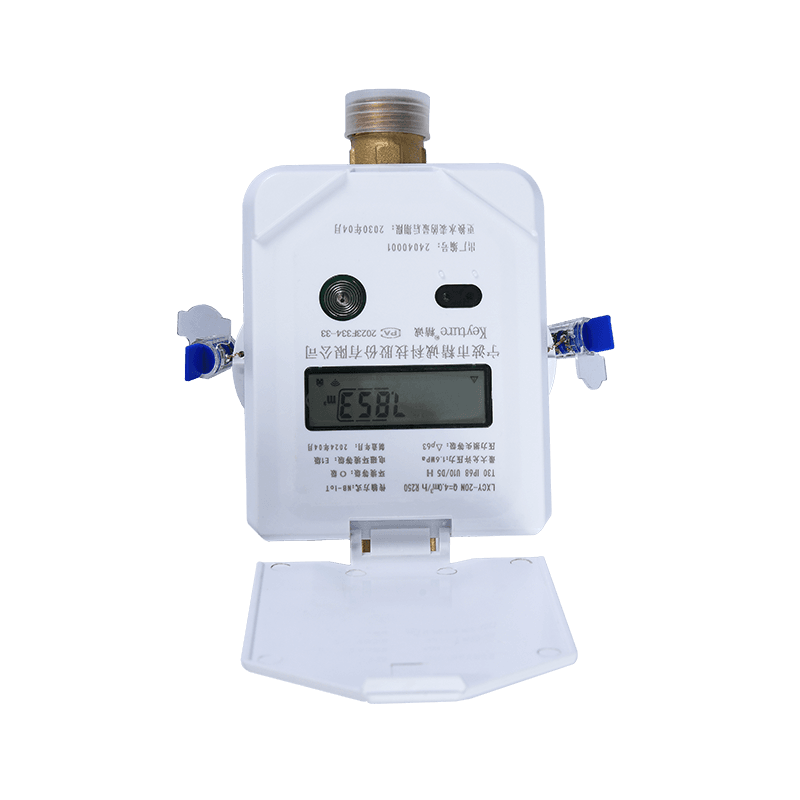 KM07-01 Domestic Ultrasonic Water Meter for Smart ReadingThis battery-powered static meter measures DN15–DN25 with high accuracy and no moving parts, supporting remote modules for AMR and connecting to communication networks like NB-IoT or LoRaWAN.View Product →
For household and small commercial use, the KM07-01 ultrasonic meter covers DN15 to DN25 and runs on battery power for a long service interval. It can be supplied as a standalone static meter or with a remote module when the project requires automated meter reading. Users looking for communication options can also combine electronic meters with prepayment functions, valve control, or water leak alarms.
The selection process should start with the flow profile, not the price list. If most consumption happens at slow overnight leakage or low-flow use, a positive displacement meter will catch small volumes that a velocity meter may miss. If the pipe size is large and flow varies widely, a Woltman meter or an ultrasonic meter is more appropriate.
Choose a meter with a start-up flow below the lowest flow you need to register. For residential connections, R160 or higher gives better low-flow sensitivity.
Velocity meters and electronic meters scale more easily to large diameters. Woltman meters are typical for DN50 and above; ultrasonic meters are also available in bulk sizes.
Mechanical meters work fine in treated water. A rotary piston meter has tighter clearances, so a strainer is recommended. Electromagnetic meters need conductive water, which is normal for mains water.
If the goal is monthly manual reading, a dry dial mechanical meter is enough. If you need hourly data, prepayment, or automatic leak alerts, choose an electronic meter with a wireless module.
Accuracy class should also be reviewed against ISO 4064. Ratings such as R80, R160, or R250 indicate the ratio between minimum and maximum flow. A higher R number means better low-flow accuracy. Keyture supplies mechanical and electronic meters in classes from R80 to R400 depending on the model and configuration.
Even a well-selected meter can read incorrectly if the installation creates a distorted flow profile. Keep these conditions in mind:
By checking these installation factors, a project team can avoid the most common sources of field error before they start billing or monitoring.
The same meter type can perform very differently depending on materials, assembly tolerance, and quality control. A factory that has produced water meters for more than two decades, and also manufactures meter bodies, registers, and mechanisms, can offer more consistent calibration and spare-part support. The Keyture facility in Ningbo, China, follows ISO 9001 for quality management, ISO 14001 for environmental management, and ISO 45001 for occupational safety.
For international projects, it is worth checking the calibration certificates, pressure loss data, and the register type. Dry-dial registers avoid fogging, liquid-sealed registers protect the gear train, and semi-liquid-sealed options balance both. If you are sourcing meters for a utility, a contractor, or a property developer, contact the factory team about meter configuration before setting the delivery schedule. Learn more about our working history and capabilities on our company background page.
The three broad types are positive displacement (volumetric) meters, velocity meters (single-jet, multi-jet, Woltman/turbine), and electronic meters (ultrasonic and electromagnetic). Mechanical variants are usually chosen for simple installations; electronic meters are chosen when remote reading and real-time data are required.
Positive displacement meters generally provide the highest accuracy at very low flow because each chamber volume is counted directly. Among velocity meters, multi-jet designs perform better than single-jet at low flow. Electronic ultrasonic meters also perform well at low flow when the pipe is full and free of air.
Yes, in most clean-water installations an ultrasonic meter can replace a mechanical meter of the same diameter. Connection sizes are standard, and pressure loss is usually lower. The main check is whether the meter body material is compatible with the supply water and whether a remote module is needed.
No. Smart meters with NB-IoT, LoRaWAN, or wired remote outputs transmit readings automatically. Mechanical meters with pulse output need a concentrator or data logger; fully static ultrasonic or electromagnetic meters often have the communication module built in.
prevNo next article
nextCommon Water Meter Problems: 8 Signs, Causes, and Fixes for Accurate Metering


Address: No.168,LinMu Rd.,Zone B, Jiangbei investment Park, Ningbo, Zhejiang,China
Tel: +86-0574-83090480/+86-18892665118
Fax: +86-0574-83021045
Email: [email protected]
Web: https://www.keyturemeter.com/
Quick Links
Product
Mobile terminal
 Wholesale Potable Water Flow Meter Manufacturers