English
 Español


Q3 is the permanent flow rate, the largest flow a meter must measure continuously, hour after hour, while staying inside its error limits. Q1 is the minimum flow it must still register. Divide Q3 by Q1 and you get the R number printed on the datasheet. A DN15 meter with a Q3 of 2.5 m³/h rated R160 carries a Q1 of 15.6 L/h. The same body rated R80 carries a Q1 of 31.3 L/h. The dial does not change. The blind spot at the bottom of the range doubles.
That ratio is what a buyer actually pays for when moving from an R80 meter to an R160 meter. R160 is not an accuracy grade and it does not describe how close a reading sits to the true volume. It describes how wide the measuring window is. The error limits themselves come from ISO 4064-1 and OIML R49 and stay the same whichever R value is chosen: plus or minus 5% between Q1 and Q2, plus or minus 2% between Q2 and Q4 for cold water.
The practical order of selection therefore runs the opposite way from most sales sheets. Fix Q3 from the design flow first, choose the R rating from the leakage profile and the water tariff second, and settle display, communication and price last.
Until the 2014 revision of ISO 4064, most datasheets used Qn, the nominal flow rate. The newer standard renamed the same idea Q3, permanent flow rate, and tightened what it means: the meter has to hold its high-zone error limit at Q3 continuously, not only during a short bench test.
Q3 is a design decision, not a fixed property of a size. A DN15 mechanical meter is commonly built at Q3 = 2.5 m³/h, but 1.5 m³/h and 4 m³/h versions exist for different pressure-loss and range targets. Two meters with identical brass bodies can therefore carry very different R ratings simply because their Q3 differs.
Above Q3 sits Q4, the overload flow rate, normally 1.25 times Q3 on mechanical designs. A meter may pass Q4 for short periods without damage, but Q4 is not a working flow and should never be used for sizing.
| Nominal size | Typical Q3 | Q1 at R80 | Q1 at R160 | Q1 at R250 |
|---|---|---|---|---|
| DN15 | 2.5 m³/h | 31.3 L/h | 15.6 L/h | 10.0 L/h |
| DN20 | 4.0 m³/h | 50.0 L/h | 25.0 L/h | 16.0 L/h |
| DN25 | 6.3 m³/h | 78.8 L/h | 39.4 L/h | 25.2 L/h |
| DN32 | 10 m³/h | 125.0 L/h | 62.5 L/h | 40.0 L/h |
| DN40 | 16 m³/h | 200.0 L/h | 100.0 L/h | 64.0 L/h |
| DN50 | 25 m³/h | 312.5 L/h | 156.3 L/h | 100.0 L/h |
Read the table from the right. A DN25 meter built at R250 starts registering at 25.2 L/h, while the same size at R160 starts at 39.4 L/h and at R80 only at 78.8 L/h. On a block of apartments where night flow rarely drops below 60 L/h per riser, that difference decides whether small leaks ever reach the billing system.
Four flow points define a meter, and R160 is simply shorthand for the relationship between two of them.
Take a DN20 meter with Q3 = 4 m³/h and an R160 rating. Working backwards: Q1 = 4 ÷ 160 = 0.025 m³/h, or 25 L/h. Q2 = 1.6 × 25 = 40 L/h. Q4 = 1.25 × 4 = 5 m³/h. Those four numbers, not the R value alone, tell an installer how the meter will behave across the whole operating range.
Verification under ISO 4064-2 samples each of these points. A meter that passes at Q3 but drifts at Q1 will still ship with R160 on the label, because the label describes a ratio and not a measured performance curve. That is why test reports matter more than the headline number.
ISO 4064-1 sets the maximum permissible error in two zones. Between Q1 and Q2 the limit is plus or minus 5%. Between Q2 and Q4 it tightens to plus or minus 2% for water at 0.1 to 30°C, and relaxes to plus or minus 3% for higher temperature bands up to 50°C. These figures do not move when the R rating moves.
What R160 changes is where the switch happens. Because Q2 sits at 1.6 × Q1, a higher R rating pushes the tighter plus or minus 2% band further down the scale. An R160 meter holds the tight band from 25 L/h upward on the DN20 example above, while an R80 version only reaches it at 50 L/h.
Older catalogues still show the A, B, C and D letter grades. Those belonged to the previous edition of the standard and described the ratio of minimum flow to nominal flow in a different way. They are not directly interchangeable with R values, and quoting an old C-class meter as if it were R160 is a common source of confusion in tender documents.
The rating ladder is not a quality ranking. Each step buys a narrower blind spot and costs something in price, filtration sensitivity or maintenance attention.
Traditional multi-jet dry dial. Lowest cost, widest blind spot, most tolerant of gritty water. Still adequate where tariffs are low and leakage is not a priority.
The current default for residential and light commercial metering. Balanced cost, good low-flow capture, works with standard strainers and normal hardness levels.
Volumetric piston or ultrasonic designs. Excellent at trickle flows, but pistons are sensitive to sand and scale and need clean upstream filtration.
Ultrasonic and electromagnetic platforms. Used for district and bulk metering where the value of each cubic metre justifies the higher unit cost and calibration routine.
| Rating | Q3 ÷ Q1 | Typical technology | Main trade-off | Typical fit |
|---|---|---|---|---|
| R80 | 80 | Multi-jet dry dial | Large low-flow blind spot | Basic household, harsh water |
| R100 | 100 | Improved multi-jet | Modest gain over R80 | General residential |
| R160 | 160 | Dry dial, semi-liquid sealed, volumetric | Needs reasonable water quality | Apartments, mixed commercial |
| R250 | 250 | Volumetric piston, ultrasonic | Sensitive to particles and scale | High-tariff areas, leak programmes |
| R400 | 400 | Ultrasonic, electromagnetic | Higher unit cost and calibration effort | District metering, bulk supply |
For a broader walk through the R160, R200 and R400 families and how they map onto ISO 4064 test points, the guide to high-precision R160, R200 and R400 meters sets the same numbers against real acceptance criteria.
Bench numbers become money on a network with ten thousand connections. Suppose average unmetered leakage per connection sits at 20 L/h during the night hours. An R80 DN15 meter with Q1 = 31.3 L/h never sees that flow at all; the register simply stops. An R160 meter with Q1 = 15.6 L/h registers it, provided the flow stays above the starting threshold long enough to turn the mechanism.
The arithmetic is straightforward. Twenty litres per hour across ten thousand connections is 200 m³/h, or about 1.75 million cubic metres a year. At a tariff of two units per cubic metre that is roughly 3.5 million units of unbilled water moving through pipes that the utility already paid to treat and pump.
There is a second, quieter benefit. Billing disputes usually start when a consumer compares a dripping tap against a register that has not moved for a month. A meter that records small flows removes that argument before it reaches a complaint desk, and it makes night-flow analysis usable without adding a second device to the chamber.
Pushing from R160 to R250 raises unit cost, narrows the tolerated particle size and increases the chance that a volumetric measuring chamber jams in a hard-water district. The gain only appears where there is low flow to capture and a tariff high enough to make that capture valuable.
Three conditions usually justify the step up:
Where all three are missing, an R160 meter with a clean strainer and a sensible replacement cycle will outperform a neglected R400 unit every year of its service life.
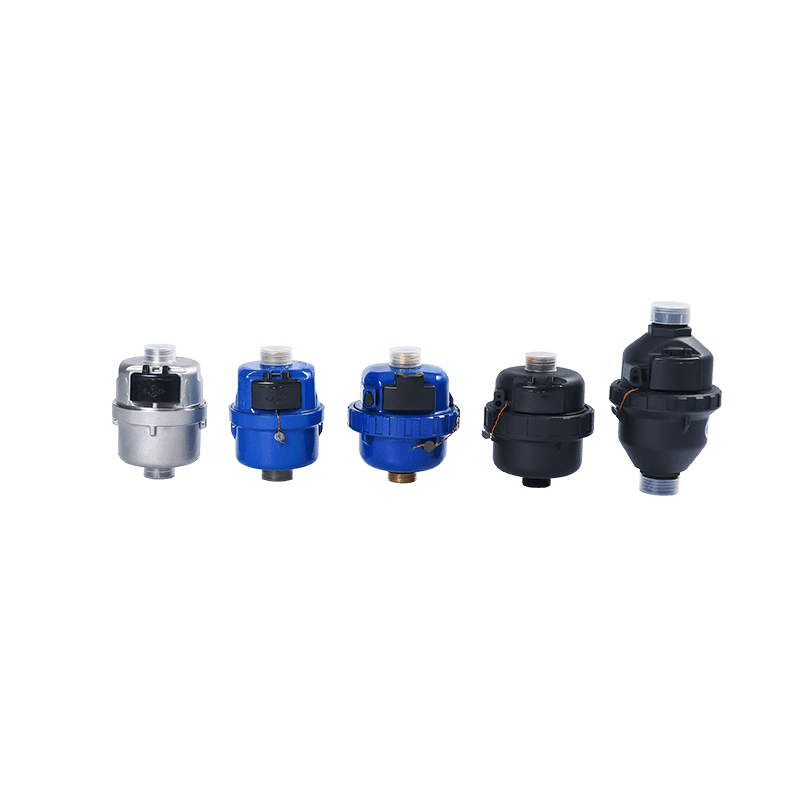 Rotary Piston Volumetric Water Meter for Residential Cold WaterThe LXH-series volumetric piston meter offers R100–R200 ratios and DN15–DN40 sizes, supporting accurate residential cold-water measurement with a sealed register.View Product →
Volumetric piston meters are the classic route to R160 and R250 in residential chambers. The measuring principle counts discrete chamber volumes rather than inferring flow from a vane, which is why the low-flow curve stays flat — and also why upstream filtration matters more than it does on a multi-jet body.
The R number is a result, not an input. It falls out of the measuring principle, the bearing design and the tolerances a factory is willing to hold.
Vane-wheel meters typically reach R80 to R160. Multi-jet designs spread the flow across several ports, which reduces jet wear and keeps the error curve stable over years. Dry-dial versions keep the register out of the water, so condensation and turbidity do not cloud the reading.
R160 to R250 is normal, with excellent performance at Q1. The piston sweeps a fixed volume, so accuracy at low flow depends less on velocity than on clearance. Fine sand is the main enemy; a 100-mesh strainer upstream is not optional.
R250 to R400 is achievable because there are no moving parts to stall. The trade-off is sensitivity to entrained air and to disturbed velocity profiles. Straight lengths upstream and downstream, plus a full pipe, matter far more than they do on a mechanical body.
 R160 Stainless Steel Drinking Water Meter with Wired Remote ReadingDN8 304 stainless-steel meter combines rotary piston measurement with RS-485 or M-BUS output for remote residential drinking-water reading.View Product →
Stainless steel wetted parts matter wherever the meter sits on a drinking water line. A 304 stainless body rated R160 with wired remote reading gives a utility the low-flow performance of the tighter ratio without introducing a polymer or coated cast iron surface into the supply path.
The same logic scales up. A DN100 bulk meter may carry a Q3 of 100 to 150 m³/h, and its R rating decides whether a 0.6 m³/h overnight trickle in a factory yard is visible. Mechanical Woltman designs generally sit between R80 and R160; ultrasonic and electromagnetic platforms reach R250 and beyond.
Two practical constraints dominate at this size. First, straight-length requirements: ultrasonic spool pieces commonly need ten diameters upstream and five downstream, and a bend or a partly closed valve immediately upstream will distort the profile and shift the reading. Second, air: large mains trap air after a repair or a pump restart, and an ultrasonic path that crosses a bubble pocket will report a flow that is not there.
 NB-IoT Bulk Ultrasonic Water Meter for Commercial and Industrial UseBattery-powered DN32–DN300 ultrasonic meter combines R400 range, IP68 protection and NB-IoT reporting for commercial and industrial supply metering.View Product →
A battery-powered bulk ultrasonic meter with NB-IoT reporting combines the wide ratio with data that arrives without a site visit. On district metering chambers and industrial supply points, that combination usually removes more cost than the meter price adds.
Pressure loss deserves a line of its own. ISO 4064 caps the loss at Q3 at 0.63 bar for most classes, but a bulk meter running near its Q3 all day will still consume pumping energy. Sizing so that the normal peak sits around 50 to 70% of Q3 keeps both accuracy and pressure loss in a sensible place.
A datasheet R160 is a laboratory figure measured on clean water at a controlled temperature. What a utility experiences is a different curve, and the gap between the two is predictable.
None of these points argue against R160. They argue for specifying the environment along with the ratio, and for writing the strainer, the orientation and the temperature class into the purchase order rather than leaving them to the installer.
Most purchasing mistakes happen because a quotation lists an R value and nothing else. The following checklist closes the gaps that the headline number leaves open.
| Item | Why it matters | Reasonable target |
|---|---|---|
| Q3 against design flow | Keeps the meter in its accurate band during peak demand | Peak flow at 50 to 70% of Q3 |
| R rating | Sets the low-flow blind spot | R160 residential, R250 or above for leak-sensitive zones |
| Q2 ÷ Q1 | Confirms the standard transition point | 1.6 |
| Q4 ÷ Q3 | Confirms overload capability | 1.25 or higher |
| Pressure loss at Q3 | Affects pumping cost and downstream pressure | 0.63 bar or lower |
| Temperature class | Prevents a cold-water body being used on hot lines | T30, T50 or T90 as required |
| Ingress protection | Buried chambers and flooded pits are normal | IP68 for below-ground installation |
| Verification report | Needed for trade settlement and customs | OIML or ISO 4064 test data per batch |
Two further questions are worth asking even though they rarely appear on a datasheet. First, what is the starting flow, the point at which the register begins to move at all? It sits below Q1 and it determines whether a slow drip is visible. Second, what is the factory's calibration interval and drift history on this model? A stable R160 beats an ambitious R250 that needs recalibration every two years.
Range ratio is a new-meter property. What a utility lives with is the ratio after several years of service, and that depends on wear, water chemistry and how the meter was installed.
Type testing under ISO 4064-2 includes a durability sequence that runs the meter through repeated cycles before re-checking the error curve. A design that passes with margin at Q1 after that sequence will usually hold its ratio in the field for the full calibration interval. A design that only just passes on a fresh unit will drift into the R80 zone quietly, with no alarm and no visible change on the dial.
Field sampling is the only reliable check. Pull a statistically useful batch each year, test at Q1, Q2 and Q3, and plot the drift. If the low-flow error has moved by more than two percentage points, the whole population is usually on the same trajectory and the replacement plan should be brought forward.
For a residential fleet on treated water with a strainer upstream, an R160 mechanical meter commonly stays inside its band for six to eight years. On untreated borehole supply with visible sand, three to four years is a realistic expectation, and no R rating survives that environment without filtration.
It is the ratio of permanent flow to minimum flow, Q3 divided by Q1. On a DN20 meter with Q3 = 4 m³/h, R160 means Q1 = 25 L/h. The meter must register flows down to that level within plus or minus 5% and hold plus or minus 2% from Q2 upward.
No. The error limits are fixed by ISO 4064-1 at plus or minus 5% and plus or minus 2% regardless of the rating. A higher R value extends the range over which the tight band applies; it does not make the band itself narrower.
They describe the same position on the flow curve, but Qn belonged to the earlier edition of the standard. Q3, permanent flow rate, carries a stricter continuous-operation requirement and is the term used in current ISO 4064 and OIML R49 documentation.
Start from the design flow to fix Q3, then look at night flow and tariff. Where low flows are common and worth billing, R160 is a sound baseline and R250 is justified. Where water is aggressive or heavily filtered options are unavailable, a well-built R80 or R100 unit with a clean strainer often outlasts a fragile high-ratio model.
The factor is written into the standard rather than chosen by the manufacturer. Fixing it at 1.6 keeps the transition point in a predictable place, so a buyer comparing two R160 meters knows that both switch to the tighter error band at the same relative position.
Only if it is built and rated for it. Above 30°C the permissible error widens to plus or minus 3%, and internal clearances, materials and the register design all change. A cold-water R160 body fitted to a hot line will lose accuracy and service life, whatever the label says.
Indirectly. A design that reaches a high ratio often uses tighter internal clearances, which can raise pressure loss at Q3. Check the declared loss at Q3 rather than assuming it, particularly on bulk meters that run near their permanent flow for long periods.


Address: No.168,LinMu Rd.,Zone B, Jiangbei investment Park, Ningbo, Zhejiang,China
Tel: +86-0574-83090480/+86-18892665118
Fax: +86-0574-83021045
Email: [email protected]
Web: https://www.keyturemeter.com/
Quick Links
Product
Mobile terminal
 Wholesale Potable Water Flow Meter Manufacturers