English
 Español


Smart water meters pay back fastest when a utility or property team treats them as a revenue-protection and operations tool, not as a gadget upgrade. The meter itself is only one part of the result. The bigger gains come from granular consumption data, faster leak detection, fewer manual reads, and a clearer record for tenant or customer disputes. A utility that moves from monthly estimates to daily interval data can usually find the first leak, stuck meter, or bypass within days rather than at the end of a billing cycle. A property manager with 300 apartments can replace a route of manual reads with exception reports and focus staff time on the small number of sites that actually need a visit.
That is why procurement conversations should start with the operating problem: non-revenue water, billing disputes, inaccessible meters, prepaid arrears, or a mixed portfolio of old mechanical meters. The right specification follows from those problems. A DN15 residential wireless meter, a DN100 ultrasonic bulk meter, and a prepaid STS meter with a motorized valve solve different problems, even though all three may be described as “smart.” The sections below set out what utilities and property managers actually gain, where the risks sit, and how to compare options without overbuying.
For most water utilities, the first measurable return from smart metering is a reduction in non-revenue water. The reason is simple: a mechanical meter at the end of its service life can under-register small flows, while a blocked or bypassed service line can run unnoticed for months. Smart meters do not repair the network, but they make the network visible. Daily or hourly consumption data lets a utility compare a district meter area’s bulk inflow with the sum of customer meters and narrow the gap to a street, a block, or a single service connection.
A practical example is a district with 2,000 connections and 28% non-revenue water. If the utility installs smart meters on the customer side and a bulk meter at the district inlet, the first target is not the whole 28%. The target is the unexplained difference that appears at night, when legitimate consumption is low. A night-flow analysis can separate background leakage from real customer use. Many utilities find that 4 to 8 percentage points of the loss sit in a small number of leaking service lines, faulty floats, or unmetered connections. Fixing those first usually costs less than replacing every meter in the district.
Smart metering also changes the speed of detection. A conventional cycle may identify a leak 30 to 60 days after it begins. A wireless meter sending daily reads can flag a continuous flow within 24 to 48 hours, depending on the data platform. For a multi-storey property, that difference can be the cost of one flooded riser versus a repaired valve. For a utility, it can be the difference between a small main repair and a road closure.
One caution is important. Non-revenue water calculations are only as good as the bulk meter and the customer index. A smart customer meter paired with an uncalibrated bulk meter can create a false sense of accuracy. Before a large rollout, verify the bulk measurement and confirm that the district boundaries are closed. Otherwise, the new data will be precise but the water balance will still be wrong.
Billing accuracy improves in two ways. First, actual reads replace estimates, so customers see a bill that matches consumption. Second, the meter records events that a manual reader cannot see, such as reverse flow, tamper attempts, magnetic interference, or a valve left partially closed. For a utility, that record reduces the time spent defending disputed bills. For a customer, it provides a clear explanation of why a bill changed.
Field labor is often the largest avoidable cost in a metering program. A manual read route of 5,000 meters may take two staff several days each month, plus travel, access calls, and re-visits for locked gates. A wireless or wired remote system does not eliminate field work, but it changes the mix. Staff move from routine reading to verification, repair, and customer service. In a well-run rollout, the routine read cost can fall by 60% to 90%, while the number of exceptions handled per technician rises because the data is better targeted.
The operational gain is not only cost. It is response time. If a meter reports a burst at 02:00, the utility can dispatch a crew before the customer calls. If a prepaid meter reports a valve failure, the property manager can act before tenants lose supply. These are practical service improvements that appear in complaint volumes and call-center queues, not only in spreadsheets.
Procurement teams should ask for the exception logic, not just the communication technology. A meter that sends data every hour but has no useful alarm thresholds will create a data lake, not an operating tool. Ask the supplier to show how continuous flow, zero flow, reverse flow, and low battery are classified, how long an alarm remains active, and how the platform prevents alarm fatigue. A simple rule set that the field team trusts is more valuable than a long list of unmanaged events.
Property managers have a different problem from a water utility. They often manage a mixed portfolio: apartments, serviced rooms, small commercial units, and shared facilities. The metering boundary is not always clear, and tenant turnover creates a recurring risk of unpaid consumption. A smart meter helps because it separates consumption by unit, records the time of use, and can support prepaid or credit-control models where local rules allow.
Prepaid metering is particularly useful in rented accommodation, worker camps, and multi-tenant buildings. An IC card, RF card, or STS keypad meter lets the occupant buy credit before use. A motorized valve closes when credit reaches zero, and the manager avoids chasing arrears after the tenant leaves. The important specification is not only the payment method. It is the valve reliability, the low-credit warning, the emergency credit setting, and the audit trail. A prepaid meter with a weak valve can create more complaints than it solves.
 Split STS Prepaid Water Meter with LoRaWANA keypad prepaid water meter with split CIU, motorized valve control, low-credit warning, and LoRaWAN-ready communication for multi-tenant prepaid water service.View Product →
For a property with unreliable mobile coverage, a split STS prepaid meter with LoRaWAN can be a practical choice because the display and keypad stay with the tenant while the communication module can be positioned for better signal. For a building with a central management office, a wireless remote meter with daily reads may be enough. The decision should be based on who needs the data, how often, and what action follows. A landlord who only needs monthly billing does not need minute-by-minute data. A manager who must detect shared-line tampering does.
Use individual meters to separate consumption and reduce disputes over shared costs. Keep a clear reading trail for move-in and move-out.
Prepaid or credit-limit meters fit rented units where collection risk is high. Confirm local rules and set a fair emergency credit allowance.
Sub-meter shared facilities separately so cleaning, irrigation, and plant room use do not distort tenant bills.
Property managers should also plan for access. Even a remote meter needs a physical installation point, a safe cable route, and a way to replace batteries or valves. In older buildings, meter rooms are often crowded and pipework is not straight. A site survey before purchase is cheaper than a retrofit after delivery. Check the pipe diameter, thread type, straight-pipe requirements, and whether the meter can be installed horizontally or vertically. A meter that fits the pipe but not the available space is a costly mistake.
There is no single smart meter that fits every connection. Mechanical meters remain cost-effective for clean water, stable flow, and budget-sensitive residential rollouts. Ultrasonic meters are strong where low start-up flow, wide range ratio, and no moving parts matter. Electromagnetic meters fit conductive liquids and larger pipes where pressure loss must be low. Prepaid meters add revenue control. The communication layer then determines how the data reaches the billing or management system.
 NB Bulk Ultrasonic Remote Water MeterA bulk ultrasonic meter for commercial and industrial water measurement, with no moving parts, wide range ratio, and selectable NB-IoT, LoRa, RS485, or M-Bus communication.View Product →
For a utility with a large residential base and limited capital, a phased mix is often sensible. Start with mechanical or ultrasonic residential meters in the areas with the highest commercial loss. Use bulk ultrasonic or electromagnetic meters at district inlets and large industrial customers. Use NB-IoT or LoRaWAN where deep indoor coverage or low power is the main constraint. Use RS485 or M-Bus where a wired building network already exists and a local concentrator can be powered. The worst approach is to choose one communication method for every site because it simplifies the purchase order but ignores the installation reality.
Communication choice has a direct effect on maintenance. NB-IoT meters are usually simple to install because they use licensed cellular networks, but signal strength inside basements and meter cabinets must be checked. LoRaWAN can be cost-effective in a campus or estate where the operator controls the gateway, but coverage planning is required. Wired RS485 and M-Bus systems are reliable in new buildings with cable routes, but retrofit costs can be high. Prepaid STS meters may not need real-time communication at all if the credit is carried on the keypad or card, but the tariff and token system must be secure.
| Option | Typical fit | Data cadence | Procurement note |
|---|---|---|---|
| NB-IoT | Residential and commercial sites with cellular coverage | Hourly to daily | Check indoor signal and SIM lifecycle cost |
| LoRaWAN | Campuses, estates, and managed districts | Daily or configurable | Plan gateway coverage and network ownership |
| RS485 / M-Bus | New buildings and wired plant rooms | Polled on demand | Include cable, concentrator, and power protection |
| Prepaid IC / RF / STS | Rented units and credit-controlled supply points | Event-based | Verify valve reliability and token security |
Mechanical and ultrasonic meters are not opposites. Many portfolios need both. A useful comparison of ultrasonic versus mechanical metering should include start-up flow, pressure loss, wear, and maintenance access, not only purchase price. A cheap mechanical meter that needs frequent replacement can cost more over ten years than a higher-priced ultrasonic meter with a stable measurement path.
Accuracy claims need to be read with the operating range in mind. ISO 4064 and OIML R49 use terms such as Q3, Q1, and the range ratio. A meter rated R160 has a Q3/Q1 ratio of 160; R200 means 200; R400 means 400. A higher ratio indicates that the meter can measure lower flows within its accuracy class, but it does not automatically mean the meter is better for every site. The question is whether the expected night flow and small tenant draw fall inside the accurate range.
For a residential connection with a nominal flow around 1.5 m³/h, a meter with a low Q1 can capture small leaks and trickle use that a lower-range meter might miss. That matters for non-revenue water and for fairness to the customer. For a large industrial connection with stable high flow, a wide range may be less important than pressure loss and long-term stability. For a property with many small units, a high range ratio can reduce disputes over low consumption, but the installer must still respect straight-pipe requirements and flow direction.
| Class or ratio | Practical meaning | Where it helps | What to verify |
|---|---|---|---|
| R160 | Q3/Q1 = 160, common for residential and light commercial meters | Households, apartments, small shops | Q1 is low enough for expected night flow |
| R200 | Wider range than R160, useful where low flows matter | Mixed-use buildings and older networks | Pressure and water quality do not undermine accuracy |
| R400 | Very wide range, often linked to ultrasonic or high-performance meters | Leak-sensitive districts and premium billing | Cost is justified by loss reduction or dispute reduction |
Procurement teams should ask for the test report, not only the catalogue page. Check the flow points used for the accuracy curve, the pressure loss at Q3, the maximum permissible error, and the meter’s behavior at low flow. For a high-accuracy ultrasonic option, review the high-accuracy ultrasonic water meter specification against the actual pipe size and expected flow profile. A meter can be accurate on a test bench and still perform poorly if it is installed after a sharp bend or with air entrainment in the line.
One common procurement risk is mixing accuracy classes across a district and then comparing the totals without normalization. If half the district uses R160 mechanical meters and half uses R400 ultrasonic meters, the apparent change in non-revenue water may reflect the meter mix rather than a real network improvement. Keep a control sample of the old meters for at least one billing cycle, or install new meters in matched pairs where feasible.
The installed cost of a smart meter includes much more than the meter price. It includes the survey, pipe modification, valve, fittings, cable, gateway or SIM, commissioning, software integration, training, and battery replacement. A unit that costs 20% more at the factory can be cheaper over ten years if it avoids one call-out per year. A cheaper unit can be expensive if its valve seizes, its display fogs, or its battery cannot be replaced in the field.
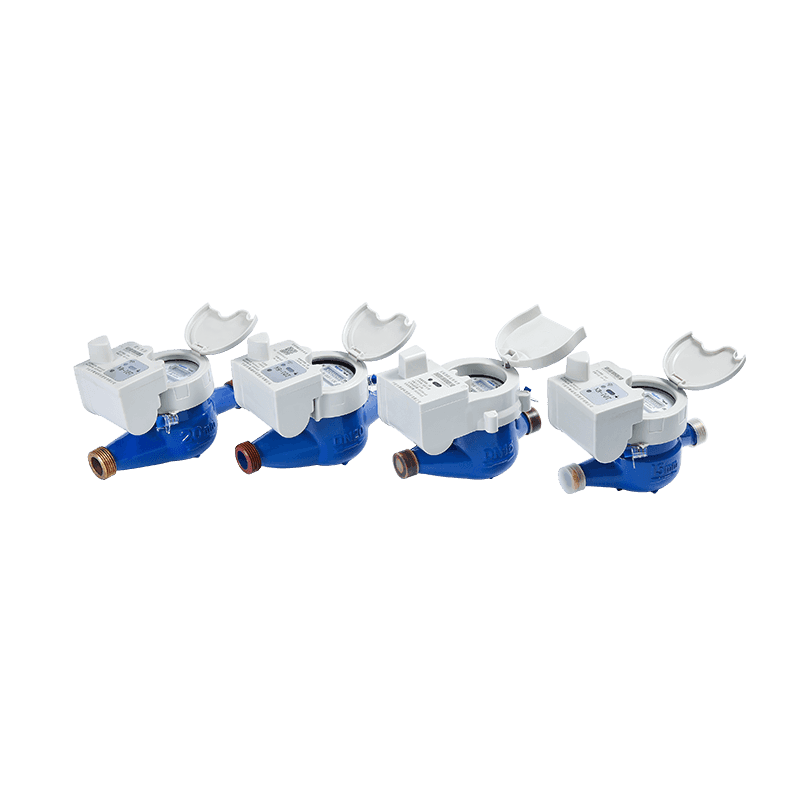 Iron Body IP68 Wireless Remote Water MeterA split wireless remote water meter with IP68 protection, replaceable battery chamber, and NB-IoT or LoRa upload for damp or flooded meter pits.View Product →
Environment is the first filter. Indoor meter cabinets can be damp. Outdoor pits can flood. Basements may have poor signal. A wireless remote meter with IP68 protection is a sensible choice for pits and wet risers, but the installer still needs to protect the cable entry and leave a service loop. For drinking water applications, use a meter with a stainless-steel body and materials that meet local potable-water requirements. For hot-water or heat-metering applications, confirm the temperature rating and the effect of thermal expansion on the meter body.
Water quality is the second filter. Mechanical meters can be affected by sand, scale, and debris. Ultrasonic meters can be affected by air bubbles and certain suspended solids. Magnetic meters require conductive water and a full pipe. If the supply is intermittent or the line is prone to air entrainment, the meter choice and installation point should be adjusted. In some buildings, a filter or a straightening section upstream is cheaper than repeated accuracy complaints.
Battery life is the third filter. A quoted ten-year life is usually based on a specific read frequency, temperature, and signal quality. If the meter sends hourly data through a weak signal, the battery may not last the quoted period. Ask for the assumptions in writing: read interval, payload size, retry logic, and operating temperature. For a property portfolio, keep a replacement budget per meter per year rather than assuming the battery will last forever.
The installation environment also affects data quality. A meter installed close to a bend, pump, or partly closed valve may record noise or distorted flow. A meter installed in a pit with standing water may suffer cable ingress. A meter installed in a metal cabinet may lose radio signal. Before a block rollout, complete a sample installation at the worst site, not the easiest one. If the signal and access work there, the rest of the rollout is more predictable.
A large smart-meter program fails more often from poor sequencing than from poor hardware. The safest path is to prove the operating model on a small district, then scale by exception. The sequence below keeps capital exposure low and gives the finance team evidence before the next budget release.
For property managers, the sequence is shorter but still needs a baseline. Record the current read method, tenant complaint reasons, arrears pattern, and valve failure history. Install the first batch in one building or one tenant group. Compare the time spent on billing, the number of access visits, and the arrears recovery. If the prepaid model is used, test the emergency credit and the low-credit warning with real tenants before going live across the portfolio.
Data integration is often underestimated. A meter that sends data to a supplier portal but cannot feed the billing system creates double work. Before purchase, confirm the API, the data format, the time stamp, and the ownership of the data. Ask how missing reads are handled, how the platform corrects clock drift, and how the meter identifier maps to the customer account. A simple CSV export can be enough for a small property portfolio; a utility may need a standard protocol and a staging database.
The business case should be built from a small number of metrics that operations staff can influence. Non-revenue water is the headline, but it moves slowly. Billing accuracy, read cost, exception closure time, and arrears recovery move faster and show whether the program is working. Use the same definitions across pilot and scale so the comparison is honest.
Track the district water balance monthly. Separate background leakage, reported leaks, and unmetered use.
Compare manual route cost with remote read cost, including exceptions and verification visits.
Measure the hours from alarm to field confirmation, not only the number of alarms raised.
Count tenant or customer billing disputes per 1,000 accounts and review the reasons.
The chart is illustrative, not a guarantee. Its purpose is to show the pattern a pilot should test: non-revenue water falls in steps, while read cost falls quickly. If a pilot shows a large fall in read cost but no change in non-revenue water, the meter may be working but the leak-response process is not. If non-revenue water falls but complaints rise, the alarm thresholds or the customer communication need review.
Most smart-meter problems are predictable. They appear at the valve, the battery, the signal path, the pipe condition, or the handover between supplier and operations team. A specification that names these risks and assigns responsibility is more useful than a long list of optional features.
| Failure point | Field symptom | Specification safeguard |
|---|---|---|
| Valve seizure | Prepaid meter does not close or open; tenant has credit but no water | Require valve cycle testing and a manual override procedure |
| Battery depletion | Missing reads, low-battery alarm, or meter drops off the network | Agree read interval and replacement interval in writing |
| Signal loss | Daily reads arrive late or not at all from basements and pits | Survey the worst site; use external antenna or another communication path |
| Air in the line | Ultrasonic meter overreads or alarms on low flow | Install at a stable point and provide air-release or filtering where needed |
| Debris and scale | Mechanical meter under-registers or stops | Use a strainer and a service plan; match meter type to water quality |
| Data handover gap | Reads sit in a portal but never reach billing | Test the API and account mapping before the first live cycle |
Another common gap is ownership of the alarm. A meter can raise a continuous-flow alarm, but if no one is assigned to review it, the alarm becomes noise. Name the role, the response time, and the escalation path. For a property portfolio, the property manager may own the first response and the plumber may own the second. For a utility, the leak team may own field verification while customer service owns tenant communication. The technology only helps when the process behind it is clear.
The first measurable benefit is usually faster leak and exception detection, followed by lower manual read costs. Non-revenue water reduction depends on how quickly the utility acts on the data. If the field response is slow, the meter data will not reduce losses.
It depends on the building size and the current problem. If the manager spends several days per month reading meters, chasing arrears, or resolving shared-cost disputes, individual smart meters can pay back through time savings and clearer billing. For a small building with easy access and no arrears problem, a simpler remote-read meter may be enough.
Prepaid is useful where collection risk is high or tenants change frequently. Postpaid is simpler where tenants are stable and the manager already has a reliable billing process. Many portfolios use both: prepaid for rented rooms and postpaid for owner-occupied units or common areas.
Daily data is enough for most billing and leak-detection programs. Hourly data helps with night-flow analysis and burst detection but increases battery use and data volume. Choose the interval based on the action you can actually take. If the team cannot respond to an hourly alarm, daily data may be a better operational fit.
IP68 indicates a high level of dust and water protection, but it is not a permanent guarantee. The installation still needs a protected cable entry, a service loop, and a suitable pit or cabinet. A flooded pit can stress any seal over time, so periodic inspection remains necessary.
Usually yes, but the pipe length, thread, straight-pipe requirement, and flow direction must be checked. Some smart meters are longer than the old mechanical unit, and some require a minimum upstream and downstream straight section. A site survey avoids adapters that distort flow or create leaks.
Ask for the baseline data, the pilot boundary, the meter mix, the exception rules, the integration method, and the success metrics. Confirm who owns the data, who responds to alarms, and how the pilot will be compared with the control area. A pilot without a control group can easily produce a result that cannot be repeated.


Address: No.168,LinMu Rd.,Zone B, Jiangbei investment Park, Ningbo, Zhejiang,China
Tel: +86-0574-83090480/+86-18892665118
Fax: +86-0574-83021045
Email: [email protected]
Web: https://www.keyturemeter.com/
Quick Links
Product
Mobile terminal
 Wholesale Potable Water Flow Meter Manufacturers