English
 Español


From nominal diameter and flow ratings to measuring principles, materials, communications and procurement, here is what decides whether a meter earns its place in the pipe.
A DN20 meter will not bolt onto a DN25 riser without a pair of reducers, and those reducers create a slow-moving pocket of water right where the impeller needs a clean, straight approach. Diameter comes first because it decides the thread, the body material, the measuring principle, and even whether the unit has room for a valve and a radio module.
DN — diamètre nominal — is a size label, not a measured bore. A DN15 brass body carries a half-inch thread, but the water still has to pass through the strainer, the impeller cage and the counter drive, so the effective measuring section is narrower than 15 mm. Two meters marked DN25 from two factories can therefore deliver different Q3 ratings, different head loss curves and different low-flow behaviour. The label tells you what the pipe expects; the datasheet tells you what the meter can actually do.
Q3 around 2.5 m³/h
Single apartment, one bathroom group, kitchen tap. The workhorse of residential sub-metering.
Q3 around 4 m³/h
Apartment with two bathrooms, small shop, or a flat with a garden tap. The most common upgrade from DN15.
Q3 around 6.3 m³/h
Villa, café, small office floor. Handles simultaneous draw from several outlets.
Q3 around 10 m³/h
Small hotel wing, laundry, car wash bay. Where peak demand starts to matter more than average flow.
Q3 around 16 m³/h
School block, commercial building riser, small factory intake.
Q3 around 25 m³/h
Factory supply, irrigation main, district branch line. Available in threaded and flanged versions.
Default permanent flow (Q3) by nominal diameter, m³/h
The table above is a starting point, not a specification. ISO 4064 assigns a default Q3 to each nominal diameter, but manufacturers are free to build meters that exceed or fall short of that figure. A high-range DN25 with a flanged body can be certified well above the default, while a low-cost DN25 mechanical meter may struggle to stay within tolerance once the flow passes 4 m³/h. The only reliable method is to lay the actual datasheet next to the actual pipe schedule.
Every meter has a Q1 — the smallest flow it is obliged to register accurately. Fit a DN25 where a DN20 belongs and Q1 rises sharply. A dripping inlet valve moving 8 litres per hour will fall below that threshold and never appear on the register, month after month.
A DN15 pushed to 3 m³/h spends its working life near or above Q3. Velocity climbs, head loss climbs with it, the impeller bearing runs hot, and the meter drifts low within two or three years — usually in the customer's favour and the utility's loss.
A horizontally calibrated meter installed vertically can read outside its accuracy class. So can a unit fitted backwards, mounted within one pipe diameter of an elbow, or sitting on a half-empty pipe. Sizing and installation are two halves of the same decision.
The oversizing problem deserves a closer look, because it is the mistake that looks safest on paper. Designers often add margin twice: once for future demand and once for "safety". A DN50 installed on a DN32 branch will still measure a factory's main production draw correctly. It will simply miss the 40 litres per hour trickle through a leaking toilet valve in the staff washroom — and a leak that never reaches the register never reaches the maintenance ticket either. In a 200-unit residential block, that pattern of ignored low flows is often the single largest source of unbilled water.
Ignore the marketing line, the photo and the colour of the lid. The selection rests on three values and one pressure rating.
| Symbol | Meaning | Example (DN20, R160) |
|---|---|---|
| Q3 | Permanent flow — the highest flow the meter may carry continuously within its accuracy class | 4 m³/h |
| Q4 | Overload flow — short-term maximum, normally 1.25 × Q3 | 5 m³/h |
| Q2 | Transitional flow — the boundary between the lower and upper accuracy zones, normally 1.6 × Q1 | 40 L/h |
| Q1 | Minimum flow — the smallest flow that must still be registered within tolerance | 25 L/h |
| R | Range ratio, R = Q3 ÷ Q1. Higher R means a wider measuring band | 160 |
| MAP | Maximum admissible pressure of the meter body | 10 bar or 16 bar |
The range ratio is where cost and performance meet. A DN20 at R80 has a Q1 of 50 litres per hour; the same diameter at R160 halves that to 25; at R250 it drops to 16. For a landlord billing a whole building through one master meter, R80 is usually acceptable because the aggregate flow never gets small. For apartment-level sub-metering, R160 is the practical floor and R250 is worth paying for wherever individual consumption is used for billing or for leak alerts.
Q (m³/h) = 3600 × v (m/s) × A (m²), where A = πd² ÷ 4
Worked example: a DN25 pipe with a 25 mm bore at a target velocity of 1.5 m/s gives A = 0.000491 m², so Q = 3600 × 1.5 × 0.000491 ≈ 2.65 m³/h. A DN25 meter with Q3 = 6.3 m³/h therefore operates at roughly 42% of its permanent rating — comfortable, quiet and well inside its accuracy band.
The curve below is a schematic, but the shape is universal. Head loss grows with the square of flow, so the last quarter of a meter's rated range typically costs far more pressure than the first three quarters combined. If a building's top-floor pressure is already marginal, an undersized meter at 90% of Q3 will show up as weak shower pressure long before anyone suspects the water meter.
Schematic head loss curves, DN20 / DN25 / DN32
From DN15 to DN40, the body is almost always threaded, and the industry standard for potable water is BSP (G) male thread, with NPT available for North American and some Middle Eastern projects. The thread is the part that breaks first in the field: cross-threading during installation, over-tightening with a pipe wrench, or a mismatched taper. Ordering the correct thread type and supplying matching unions from the same factory removes most of that risk.
At DN50 the picture splits. Both 2-inch threaded and DN50 flanged versions exist, and the choice is driven by the installation rather than by flow. Threaded DN50 is cheaper and needs no bolt alignment, which suits irrigation headers and temporary supplies. Flanged DN50 is the standard for building risers, plant rooms and any location where the meter may need to come out for verification in ten years' time without cutting the pipe.
| Consideration | Threaded (DN15–DN50) | Flanged (DN50 and above) |
|---|---|---|
| Installation speed | Fast, two wrenches, no bolt torque pattern | Slower, requires gasket alignment and staged bolt tightening |
| Replacement in service | Needs a spool piece or a union on both sides | Unbolts directly, spool piece optional |
| Risk of leakage | Higher if tape or paste is applied unevenly | Lower and more predictable, but gasket quality matters |
| Pressure class | Typically 10–16 bar on the body | PN10 or PN16, matched to the flange drilling standard |
| Best suited to | Apartment risers, small commercial, irrigation | Plant rooms, main distribution, industrial intake |
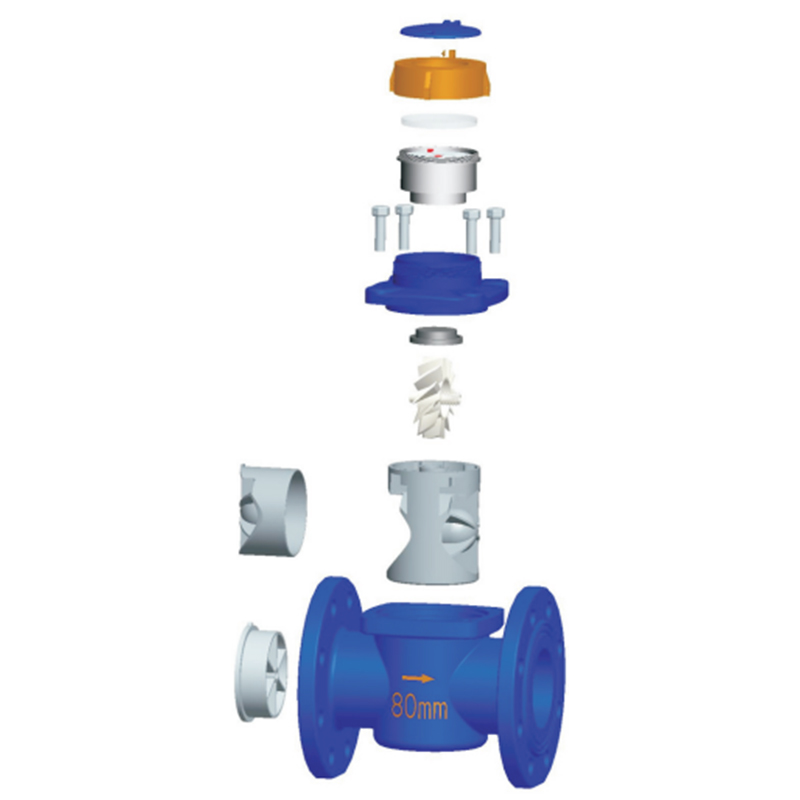 Horizontal Vane Woltman Water Meter KM06-04For DN50 plant-room or riser installations, this dry-type Woltman meter offers flange mounting, a removable measuring mechanism, and an IP68 register.View Product →
For projects that sit exactly on the boundary, the decisive question is usually maintenance access rather than flow. A DN50 flanged meter in a plant room can be swapped in twenty minutes with the line isolated; the same meter threaded into a tight ceiling void may take half a day.
Two meters of the same nominal size can behave like different products. A multi-jet mechanical unit in DN25 and an ultrasonic unit in DN25 share a thread and nothing else — different range ratio, different low-flow sensitivity, different response to sand or air, and a very different maintenance profile.
Mechanical multi-jet meters remain the default for apartment sub-metering because they are inexpensive, self-powered and easy to read. Their limitation is the moving parts: at DN15 and DN20, grit in the water wears the impeller bearing and the meter starts to read low, usually after four to six years in hard-water areas.
Volumetric piston meters handle small flows better than any mechanical alternative, which makes them attractive for DN15 and DN20 where a landlord wants the night-time drip to appear on the register. The price is sensitivity to debris — a piston meter needs a clean strainer and a supply that is not prone to flushing sediment after main repairs.
At the top of the range, ultrasonic meters have largely replaced mechanical designs for DN50 and above in new commercial work. There is nothing to wear, the measuring tube is a straight bore with negligible head loss, and the same body can carry a battery and a radio. The trade-off is a higher unit price and a need for a fully developed flow profile: an ultrasonic meter on a half-empty pipe or immediately downstream of an elbow will produce readings that drift during commissioning.
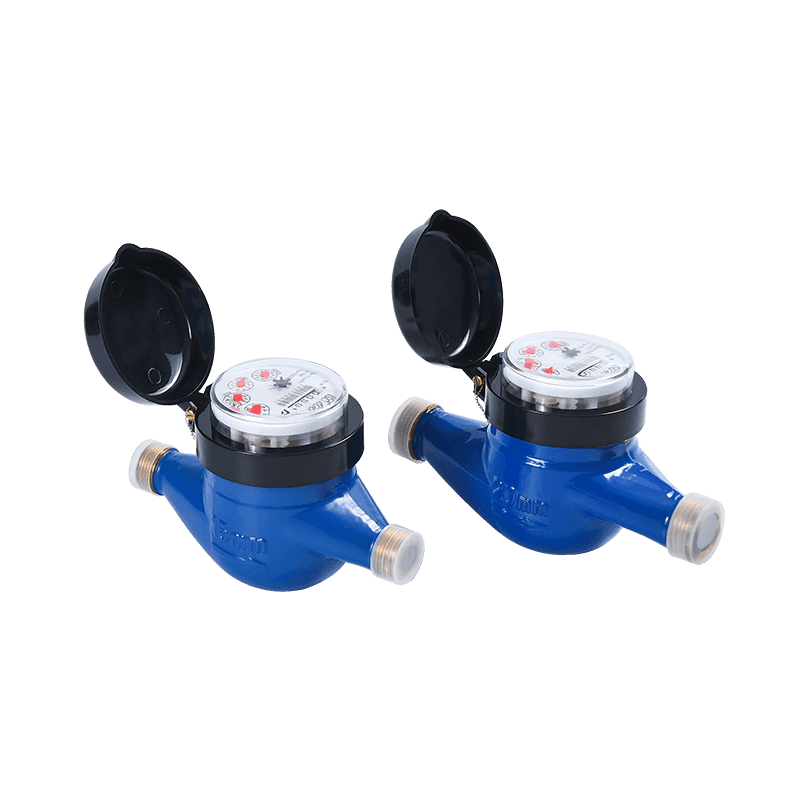 Domestic Multi Jet Cold Water Meter KM05-01For DN15–DN40 domestic cold-water lines, this multi-jet mechanical meter offers dry magnetic registers, anti-magnetic protection, and brass, iron, or plastic body options.View Product →
The practical rule that emerges from field data: below DN25, mechanical still wins on cost per measured litre; above DN40, electronic wins on lifetime cost once maintenance and revenue loss are counted. The difficult zone is DN25 to DN32, where the decision depends on water quality and on how much the operator cares about 30-litre-per-hour events.
The default for DN15–DN25 potable cold water. Good machinability, tight thread tolerance, long service life. Check the dezincification resistance on aggressive or high-chloride supplies, and confirm the lead content against the destination market's rules.
Used for DN50 and above where mechanical strength and cost dominate. Heavy, needs coating, and normally specified for irrigation, fire lines and industrial process water rather than drinking water.
Light and corrosion-proof, common in pre-paid units for social housing and rental blocks. UV stability and thread strength are the two things to test before committing a container load.
Specified for direct drinking water, purified supply and food processing. Leaves no metallic taste, tolerates chlorination, and is the only sensible choice where the meter sits downstream of a filtration or reverse-osmosis stage.
Material also changes the physical envelope. A DN50 cast iron body with a flanged connection is substantially longer and heavier than the plastic equivalent, and that difference matters when the meter is being fitted into a prefabricated meter box with a fixed depth. Confirm the face-to-face length, not just the nominal diameter, before the boxes are cast.
A meter that reports its own reading still has to fit in the same shaft. Adding a communication module or a motorised ball valve extends the body, raises the top clearance, and — in the case of valve control — can add a requirement for additional straight pipe on the downstream side.
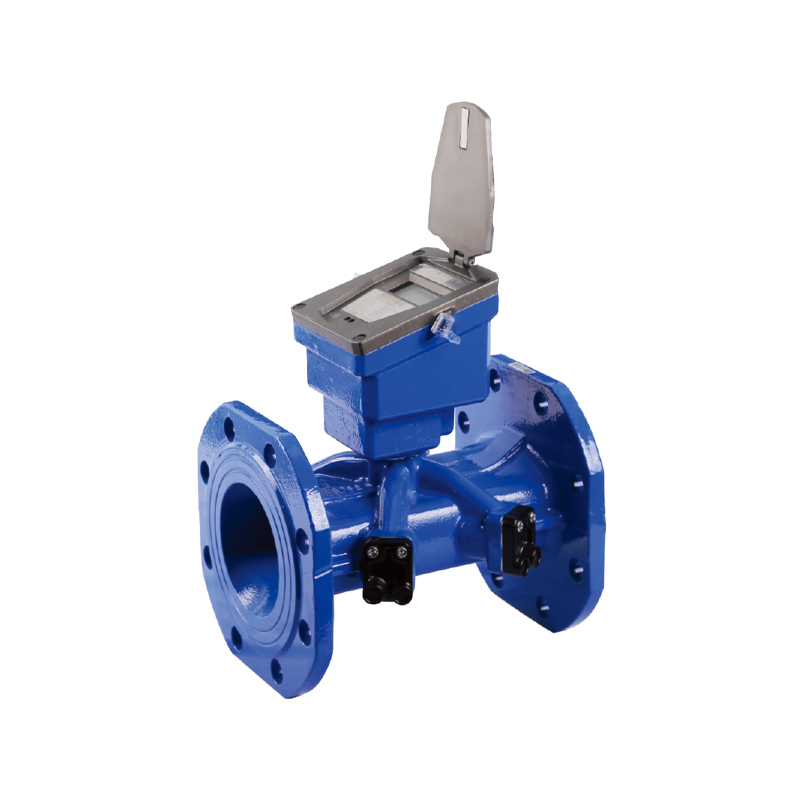 NB Bulk Ultrasonic Remote Water Meter KM07-03For remote-reading bulk installations, this DN32–DN300 ultrasonic meter offers AMR communication, no moving parts, IP68 protection, and an 8-year battery.View Product →
Battery life is the specification buyers forget to check. A DN50 ultrasonic meter reading every 15 minutes and transmitting once a day will run for years; the same unit configured to transmit on every event and poll twice an hour may exhaust its cell inside 24 months, and a battery replacement in a buried chamber is a service visit nobody wants to schedule.
Most sizing disputes that reach a factory are not about engineering at all. They are about a purchase order that specified "DN25 water meter, 100 pieces" and left everything else to interpretation.
| Item | What to state | Risk if omitted |
|---|---|---|
| Flow class | Q3 value and R ratio, not just DN | A DN25 at R63 arrives instead of the R160 that was quoted |
| Connection | Thread standard (BSP or NPT), flange drilling, face-to-face length | Unions do not match on site; the whole batch needs reworking |
| Body material | Brass grade, cast iron coating, 304 stainless, or plastic type | Dezincification complaints in year three |
| Register | Dry, wet or semi-dry; dial or cyclometer; litres or cubic metres | Readings misread by the billing team; disputes at handover |
| Pressure rating | MAP and the test pressure applied to every unit | Body failures on high-rise systems with pressure-reducing valves set high |
| Verification documents | Test report per unit or per batch, calibration certificate | Customs or utility acceptance refused at the port |
| Ingress protection | IP rating for pits and outdoor chambers | Condensation destroys the register electronics within one season |
Batch consistency is worth a separate conversation. A buyer who approves one sample and then receives a container of 2,000 units from three production lots may find the Q1 values scattered more widely than the sample suggested. Ask how the factory handles in-process calibration and whether each unit is individually tested or only sampled per lot — and ask for the test data, not just the certificate of conformity.
DN15 with Q3 2.5 m³/h covers a one-bathroom flat; step to DN20 for two bathrooms. Target R160 or above, dry dial, and a register that can be read without opening the box.
DN25 to DN32 on the kitchen branch, DN20 on guest floors. Kitchens have short, violent peaks — size for the peak, not for the average, and expect the head loss curve to matter at breakfast.
DN40 to DN50 on the block inlet, DN15 in each room. The morning shower peak is the sizing case; the rest of the day the main meter sees a fraction of that flow.
DN50 flanged, often with a bypass. Where floor-by-floor billing is required, pair the master meter with communicating sub-meters so that the difference between the two can be tracked.
DN50 or larger, flanged, with an electromagnetic or ultrasonic body if the water carries suspended solids. Verify straight-pipe availability before the pipe is fabricated, not after.
DN50 threaded is common and cheaper, but irrigation water is abrasive. Choose a meter with a replaceable mechanism so that a worn measuring unit can be swapped without cutting the line.
Read the face of the meter first — most carry the nominal size near the model number, along with Q3 and R. If the marking has faded, measure the thread across the outside of the male thread: about 20.9 mm is 1/2 inch (DN15), 26.4 mm is 3/4 inch (DN20), 33.2 mm is 1 inch (DN25), and 41.9 mm is 1 1/4 inch (DN32). Measuring the pipe is less reliable, because the meter body is usually wider than the pipe it serves.
They map onto each other but they are not identical. DN15 corresponds to 1/2 inch, DN20 to 3/4 inch, DN25 to 1 inch, DN32 to 1 1/4 inch, DN40 to 1 1/2 inch and DN50 to 2 inch. DN is a nominal designation; the inch figure refers to the connection thread, and neither number describes the internal measuring bore.
Physically yes, with two reducers. Practically, the reducers create turbulence and a lower velocity through the meter, which is acceptable on a steady industrial load but poor practice on a line that also carries small flows. If the pipe is DN25, order a DN25 meter with a suitable Q3 rather than downsizing the meter body.
R160 is the practical minimum whenever individual consumption is billed. R250 is worth the extra cost where night-time leak detection is part of the service, because it brings Q1 down to a level where a continuously dripping valve becomes visible in the consumption curve.
No, and it usually does the opposite for the utility. A larger meter measures the same high flows accurately but starts missing small ones, so recorded consumption falls while real consumption stays the same. The unbilled difference ends up either in the utility's loss figures or spread across other customers.
Threaded if the line is temporary, irrigation-based, or installed in a location with limited space. Flanged if the meter sits on a building riser, in a plant room, or anywhere it will need to be removed for verification. The flow performance is identical; the decision is about maintenance access.
Five pipe diameters upstream and three downstream is the widely accepted minimum for mechanical meters. Ultrasonic meters often benefit from ten upstream, particularly downstream of a pump, a valve or two bends in different planes. If those lengths are not available, the meter will still turn, but the accuracy class on the datasheet no longer applies.
Only if the model is explicitly rated for it. A dry-dial multi-jet calibrated on horizontal flow can shift outside its accuracy band when mounted vertically, and the error is not always small. Vertical runs are common in risers, so specify a vertical-rated body at the ordering stage rather than discovering the issue at commissioning.
Design peak for a three-bathroom house usually lands between 2.0 and 2.8 m³/h if the outlets are used with normal diversity. A DN20 with Q3 of 4 m³/h covers it comfortably at around 60–70% of the permanent rating. A DN25 is only justified where a garden irrigation line or a pool fill runs at the same time as domestic demand.
Either the flow is below Q1 and the meter is not obliged to register it, or the measuring chamber has worn or scaled. Compare the meter reading with a known volume — a 10-litre bucket filled at a slow, steady rate is a crude but useful test. If the meter is more than five years old, has been in hard water, and misses a 10-litre slow fill entirely, the mechanism rather than the diameter is the problem.


Address: No.168,LinMu Rd.,Zone B, Jiangbei investment Park, Ningbo, Zhejiang,China
Tel: +86-0574-83090480/+86-18892665118
Fax: +86-0574-83021045
Email: [email protected]
Web: https://www.keyturemeter.com/
Quick Links
Product
Mobile terminal
 Wholesale Potable Water Flow Meter Manufacturers