English
 Español
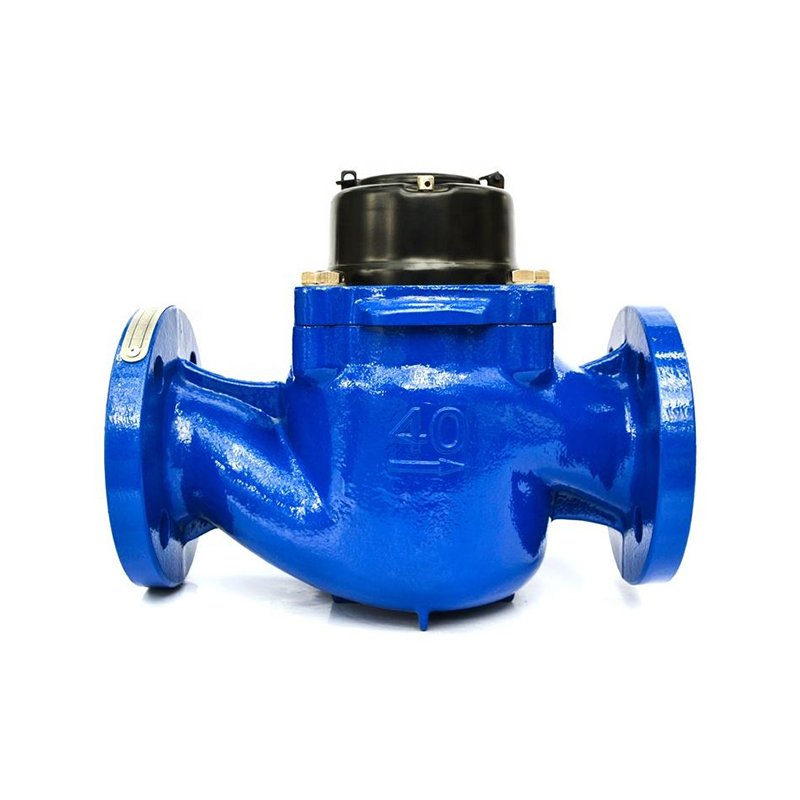


Rotary piston water meters are a representative type of positive displacement water meter. Their measuring principle is based on the periodic displacement of fixed water volumes inside a precisely formed metering chamber. Unlike velocity-type water meters that rely on water kinetic energy to drive an impeller, rotary piston water meters utilize hydraulic pressure to directly move a piston through a complete geometric cycle. This fundamental difference gives rotary piston water meters clear technical advantages in low-flow measurement, particularly in applications requiring detection of very small and continuous water consumption.
One of the most significant advantages of rotary piston water meters at low flow rates is their exceptionally low starting flow. Because piston movement depends on hydraulic pressure rather than flow velocity, even a very small amount of water can initiate rotation. With proper design and manufacturing accuracy, the starting flow rate of a rotary piston water meter is substantially lower than that of velocity-type meters of the same nominal diameter. This enables reliable measurement of dripping faucets, toilet refill leakage, and other micro-consumption events that are often missed by conventional impeller meters.
In the low-flow range, rotary piston water meters demonstrate excellent measurement linearity. Each piston cycle corresponds to a fixed and repeatable displacement volume, independent of flow fluctuations. Even when the flow rate varies or pulsates, the metered volume remains consistent. Velocity-type meters often experience unstable impeller rotation and distorted error curves under low flow conditions due to insufficient driving force. Rotary piston water meters maintain concentrated and predictable error distribution in the Q1 to Q2 flow range, supporting long-term accuracy stability.
Low-flow operation is frequently associated with low system pressure. Rotary piston water meters retain effective start-up and continuous measurement capability under reduced pressure. The sealed metering chamber efficiently converts limited hydraulic energy into piston motion. Pressure fluctuations in the supply system do not significantly interrupt piston movement. This characteristic is especially beneficial in high-rise buildings, terminal supply points, aging pipelines, and secondary water supply systems where pressure conditions are less stable.
Internal leakage control plays a crucial role in low-flow measurement accuracy. Rotary piston water meters feature close-tolerance interfaces between the piston and the metering chamber, ensuring that nearly all water passing through the meter contributes to piston displacement. At low flow rates, bypass leakage is minimized and does not dominate the measurement result. In contrast, some velocity meters allow partial water flow to bypass the impeller without generating measurable rotation, leading to under-registration at low flow. The volumetric structure of rotary piston meters offers inherent advantages in small-volume segmentation.
Rotary piston water meters are highly capable of detecting continuous micro-flows. In situations involving slow pipe leakage, imperfect valve sealing, or automatic refill systems, water may flow continuously at extremely low rates. The slow and steady piston rotation allows these small volumes to be accumulated and recorded over time. This capability supports leak detection, consumption analysis, and loss management for both utilities and end users.
Measurement repeatability is a key indicator of meter performance in the low-flow range. Rotary piston water meters produce highly consistent readings when operating repeatedly under the same low-flow conditions. The piston’s motion path is strictly constrained by the metering chamber geometry, reducing randomness and sensitivity to minor flow disturbances. This consistency contributes to stable accuracy over the service life and reduces the need for frequent recalibration or replacement.
Actual low-flow consumption often occurs in intermittent or pulsating patterns. Rotary piston water meters respond effectively to short-duration, small-volume flow pulses. Each small inflow contributes directly to piston displacement, preventing loss of measurable consumption. The fixed-volume metering chamber provides strong time-integration capability, ensuring that transient low flows are not ignored or filtered out by inertia effects.
The strong low-flow performance of rotary piston water meters delivers significant practical value in residential metering, individual apartment billing, and refined water management systems. Accurate recording of small consumption improves billing fairness and reduces disputes. Reliable low-flow data also forms a solid foundation for advanced functions such as remote reading and consumption analytics.
prevHow do ultrasonic water meters overcome the impact of water quality variations on measurement accuracy
nextWhat are the main failure points of a rotary piston water meter


Address: No.168,LinMu Rd.,Zone B, Jiangbei investment Park, Ningbo, Zhejiang,China
Tel: +86-0574-83090480/+86-18892665118
Fax: +86-0574-83021045
Email: [email protected]
Web: https://www.keyturemeter.com/
Quick Links
Product
Mobile terminal
 Wholesale Potable Water Flow Meter Manufacturers